Saudi Arabia’s labor market has undergone its most significant legal reform in two decades. The 2024–2025 amendments to the Saudi Labor Law introduced by Cabinet Decision No. 117 issued on 6 August 2024 and fully effective from 19 February 2025 rewrote 38 articles, removed seven, and added two new ones. For employers, the message is clear: the compliance bar has risen, the enforcement tools are more powerful, and the cost of getting it wrong is higher than ever.
This guide is written as an employer risk playbook, not a general legal summary. For every rule, there is a real risk, a common employer mistake, and a practical prevention step. The goal is to help your business stay on the right side of the Ministry of Human Resources and Social Development (MHRSD), the Wage Protection System, the Qiwa platform, and the Saudi labor courts before a dispute ever arises.
Employee disputes in Saudi Arabia can trigger financial penalties, labor court claims, reputational damage, operational disruption, and increased staff turnover. The single most effective way to manage all of these risks is proactive legal compliance, good documentation, and structured HR processes that hold up to scrutiny.
Key Labor Law Updates Employers Must Know (Effective 19 February 2025)
| Legal ReferenceRoyal Decree No. 44 dated 12 August 2024Cabinet Decision No. 117 dated 6 August 2024Implementing Regulations: Ministerial Decision No. 115921/1446 dated 20 February 2025Scope: 38 articles amended, 7 removed, 2 new articles added |
Royal Decree No. 44 (12 August 2024) | Effective: 19 February 2025 | Implementing Regulations: Ministerial Decision No. 115921/1446 (20 February 2025)
1. Maternity leave extended to 12 weeks: fully paid (previously 10 weeks). Six weeks after delivery are mandatory and cannot be deferred.
2. Paternity leave introduced for the first time: 3 days paid leave, to be taken within 7 days of the child’s birth.
3. Bereavement leave expanded: 3 days added for the death of a sibling, on top of existing entitlements.
4. Termination notice periods clarified: 60 days required from the employer for indefinite contracts; 30 days required from the employee.
5. Resignation procedures formalized: Postdated resignations are now prohibited. Resignations take immediate effect unless the employer defers acceptance for up to 60 days in writing for valid business reasons.
6. Bankruptcy added as a lawful termination ground: A court declaration of bankruptcy is now a valid reason to end employment contracts, provided the employee’s rights are protected.
7. Probation period confirmed at maximum 180 days: Must be specified in the written contract. Cannot be imposed verbally or extended beyond 180 days total.
8. Fixed-term contract auto-renewal rule strengthened: Non-Saudi fixed-term contracts auto-renew for the same period if both parties continue performing, unless one party gives notice to terminate.
9. Disciplinary response time for employees extended: Employees now have more time to submit a written grievance challenging a disciplinary penalty (30 days, excluding official holidays).
10. Penalties for unlicensed manpower supply: SAR 200,000 to SAR 500,000 for companies engaging in manpower supply without proper MHRSD licensing.
11. Saudization Nitaqat updates: Employees with disabilities count as 4 Saudi employees; formerly incarcerated citizens count as 2 for a two-year period. All contracts must be registered on the Qiwa platform.
The Saudi Labor Law Framework
The Saudi Labor Law, originally issued under Royal Decree No. M/51 in 2005, governs all employment relationships in the private sector. Its core objective is to balance employer and employee rights while supporting economic growth, workforce stability, and Vision 2030’s human capital development goals.
Key Regulatory Authorities
• MHRSD (Ministry of Human Resources and Social Development): The primary regulatory body. Responsible for labor inspections, dispute mediation, Saudization enforcement, and licensing. Operates the Qiwa platform for contract registration and the Wage Protection System for payroll monitoring.
• Labor Courts: Established by Royal Decree in 2018, now operating in 7 major cities (Riyadh, Dammam, Makkah, Jeddah, Buraydah, Madinah, Abha) with 27 additional circuits. Jurisdiction covers all employment disputes including wages, termination, and disciplinary actions.
• Qiwa Platform: The government’s digital hub for employment contracts, Saudization data, and labor compliance. All employment contracts must be registered on Qiwa. Contract disputes are cross-referenced with the registered Qiwa version not your internal copy.
• Najiz Portal: The Ministry of Justice’s digital service for filing and tracking labor court cases electronically after the amicable settlement stage.
Why Saudi Labor Law Compliance Matters for Businesses
| Employee disputes can trigger: Financial penalties from MHRSD for regulatory violations, Labor court claims with indemnity awards that grow with employee seniority, Suspension of MHRSD services, including visa processing, triggered by WPS violations, Reputational damage affecting recruitment and business relationships, Operational disruption from employee transfers and abrupt resignations |
| Compliance as a competitive advantage: Maintaining Platinum or Green Nitaqat status unlocks faster visa processing and government services Clean WPS records signal reliability to government and financial institutions. Low dispute rates reduce legal costs and management distraction. Documented HR processes attract and retain high-quality talent |
Most Common Employee Disputes in Saudi Arabia

Wage and Salary Disputes
Common issues
• Delayed salary payments reported through the Wage Protection System
• Unauthorized deductions from wages
• Unpaid commissions or performance bonuses that were verbally promised but not contractually captured
| Legal risk: The WPS monitors whether private-sector establishments pay wages on time and in the agreed amounts. A single WPS violation can trigger suspension of MHRSD services, including visa processing. |
| Prevention step: Pay salaries through authorized banks and financial institutions on time, every month. Ensure all allowances and commissions are written into the employment contract or a signed addendum. |
Overtime Payment Disputes
Common issues
• No records of overtime hours worked
• Overtime calculated on basic salary only, ignoring allowances
• Informal agreements to take time off instead of paying overtime, without a written agreement
| Legal riskWithout attendance records, courts assume the employee is correct. The burden of proof is on the employer to show overtime was not worked or was compensated. |
| Prevention stepInstall an automated time-tracking system. Issue monthly payslips itemizing overtime. Any compensatory time-off agreement must be in writing and signed. |
Wrongful Termination Claims
Common issues
• Termination without documented performance concerns or disciplinary history
• Failure to give 60 days’ written notice for indefinite contracts
• Skipping the formal investigation step before dismissal under Article 80
| Legal risk: Courts regularly award indemnity equivalent to two months’ wages per year of service for arbitrary dismissal, in addition to outstanding EOSB. The financial exposure grows with seniority. |
| Prevention step: Build a documented trail before termination. Review the Qiwa-registered contract before any action. Follow the Article 80 investigation procedure rigorously. |
End-of-Service Benefit (EOSB) Disputes
Common issues
• Calculating EOSB on basic salary only when the law requires actual (last full) wage
• Disputes over whether a period of leave counts toward service
• Forgetting to include the probation period in the total service calculation
| Legal riskEOSB underpayment claims are among the most common matters before Saudi labor courts. Errors are easily discovered by comparing the employment contract, payslips, and the statutory formula. |
| Prevention stepCalculate EOSB using the actual wage (basic salary plus all fixed regular allowances). Pay within one week of termination by the employer, or two weeks if the employee resigns. Audit calculations before the final settlement is issued. |
Employment Contract Violations
Common issues
• Changing an employee’s job title, duties, or work location without written consent
• Using a contract template that omits mandatory clauses such as probation terms or leave policies
• Bilingual contracts where the Arabic version differs from the English version Arabic governs in Saudi courts
| Legal risk: A contract that is silent on key terms gives the employee the statutory maximum. Courts interpret ambiguity in favor of the weaker party. |
| Prevention step: Register every contract on Qiwa. Review the Arabic version carefully. Any amendment to duties or compensation requires a signed written addendum. |
Leave and Benefits Disputes
Common issues
• Failing to grant 12 weeks of maternity leave under the 2025 amendments
• Denying sick leave without legitimate grounds
• Requiring employees to sacrifice untaken annual leave without the legally required compensation
| Legal risk: Leave violations attract fines and can trigger labor court claims with back-payment awards. The 2025 amendments on maternity and paternity leave are especially scrutinized. |
| Prevention step: Update your HR policy immediately for the 2025 leave changes. Maintain leave records and obtain written acknowledgment from employees when leave is scheduled or deferred. |
Employment Contracts The First Line of Defense

Mandatory Clauses Every Saudi Employment Contract Must Include
- Full name and address of employer and employee
- Job title and detailed description of responsibilities
- Place of work
- Agreed wage, allowances, and the basis for calculation
- Working hours and rest days
- Probation period (if applicable) must not exceed 180 days total
- Annual leave entitlement
- Termination procedures and notice periods
- End-of-service benefit terms
| Note on Qiwa Registration: All employment contracts must be registered on the Qiwa platform. In any dispute, the court compares the version the employer presents against the Qiwa-registered version. Discrepancies are treated as evidence of bad faith by the employer. |
Fixed-Term vs Indefinite Contracts
• Fixed-term contracts have a specified end date. They terminate on expiry unless explicitly renewed. If both parties continue performance after expiry, the contract converts to an indefinite contract.
• Non-Saudi fixed-term contracts that do not specify a duration are treated as running for the duration of the work permit. The 2025 amendments confirmed that these contracts auto-renew unless one party gives termination notice.
• Indefinite contracts require 60 days notice from the employer and 30 days from the employee for termination. Terminating an indefinite contract without proper grounds or notice exposes the employer to arbitrary dismissal indemnity.
Probation Period Compliance
Rule: The probation period must be stated explicitly in the written contract and cannot exceed 180 days in total. The same role cannot be subjected to multiple probation periods unless at least six months have passed since the previous employment ended.
Risk: A probation period not written into the contract cannot be enforced. Terminating an employee and claiming probation status when the contract is silent is treated as a regular termination with full rights.
Practical mistake: Verbal probation agreements, extending probation without the employee’s written consent, or relying on company policy documents that the employee never signed.
Prevention step: Include the probation clause in every contract. Set written performance objectives at the start of probation. Document evaluations monthly.
Wage Protection and Overtime Compliance
Working Hours
Standard: 8 hours per day, 48 hours per week. During Ramadan: reduced to 6 hours per day or 36 hours per week for Muslim employees.
Overtime Rule, Risk, and Prevention
Rule: Overtime is compensated at the actual hourly wage plus 50% of the basic hourly wage (Article 107). In practice this means time-and-a-half based on the blended rate of actual wages and basic salary. Alternatively, employer and employee may agree in writing to grant compensatory time off instead of payment.
All hours worked on official holidays and public vacations are treated as overtime, regardless of how many hours the employee has already worked that day.
Risk: Calculating overtime on basic salary alone ignoring housing, transport, or other fixed allowances is one of the most common errors in Saudi payroll. Courts require the actual wage to be used.
Prevention step: Review your payroll calculation method now. Ensure your time-tracking system logs all overtime hours. Issue monthly payslips itemizing overtime calculations.
| Wage Protection System (WPS): The Wage Protection System (WPS), operated by MHRSD, monitors whether private-sector employers pay wages on time and in the agreed amounts. Violations are logged automatically and can result in suspension of MHRSD services. Employers in the Red zone of Nitaqat are also at risk of losing visa-processing privileges. WPS compliance is not optional it is a continuous monitoring obligation. |
Employee Leave Entitlements 2025 Updated Rules
Annual Leave: Minimum 21 calendar days per year for the first 5 years of service with the same employer. Increases to 30 calendar days after 5 consecutive years. Untaken leave is payable in cash on termination.
Sick Leave: Employees are entitled to 30 days fully paid sick leave per year (with a valid medical certificate), followed by 60 days at 75% pay, followed by 30 additional days unpaid. After this, the employer may terminate with full EOSB entitlement.
Maternity Leave (2025): 12 weeks fully paid (extended from 10 weeks by the 2025 amendments). The 6 weeks immediately after delivery are mandatory and cannot be deferred or waived. The remaining 6 weeks may be taken at the employee’s discretion up to 4 weeks prior to the expected delivery date.
Paternity Leave (2025 NEW): 3 days paid paternity leave, to be taken within 7 days of the child’s birth. Introduced for the first time by the 2025 amendments.
Bereavement Leave (2025): Existing bereavement entitlements expanded. 3 additional days added for the death of a sibling.
Public Holidays: Employees are entitled to paid leave on officially recognized public holidays. If required to work, all hours are treated as overtime regardless of the total hours worked that day.
Termination and End-of-Service Benefits
Lawful Grounds for Termination
• Performance issues documented, with written warnings and opportunity to improve
• Misconduct following the Article 80 procedure (written investigation, employee given opportunity to respond)
• Business reasons restructuring, bankruptcy declared by a competent court (new ground added in 2025)
• Contract expiry for fixed-term contracts that are not renewed
• Mutual agreement in writing, signed by both parties
Required Notice Periods (2025 Updated)
• Indefinite contract, terminated by employer: 60 days written notice (2025 amendment clarified and increased from previous ambiguity)
• Indefinite contract, resigned by employee: 30 days written notice
• Fixed-term contract, terminated early by employer: 30 days written notice minimum
• Fixed-term contract, resigned early by employee: 30 days written notice
• During probation: Either party may terminate without notice and without payment of EOSB
Article 80 Termination for Serious Misconduct
| Read this carefully before dismissing for misconduct: Under Article 80, an employer may terminate without notice, without end-of-service benefits, and without indemnity only for nine specific grounds of serious misconduct, including assault, absence for more than 30 cumulative days or 15 consecutive days without a legitimate reason, and breach of confidentiality. However, before applying Article 80, the employer must: (1) investigate the allegation, (2) give the employee a written opportunity to respond, and (3) document both steps thoroughly. Courts reject Article 80 terminations that skip this procedure. |
EOSB Calculation Formula (Article 84)
• Years 1–5 of service: Half a month’s actual wage per year
• From year 6 onwards: One full month’s actual wage per year
• Fractions of a year: Proportionate payment based on days worked
• Basis: Actual wage meaning basic salary plus all fixed regular allowances (housing, transport, etc.)
• Payment deadline: Within 1 week if the employer terminates; within 2 weeks if the employee resigns
If an employee resigns after fewer than 2 years, no EOSB is payable. Between 2 and 10 years: one-third of EOSB if resigned. Between 10 and 20 years: two-thirds. After 20 years: full EOSB regardless of resignation. Exception: Women who resign within 6 months of marriage or 3 months of childbirth are entitled to full EOSB.
If terminated under Article 80 for proven serious misconduct, the employer may withhold EOSB entirely but this requires rigorous documentation and procedural compliance. Courts frequently overturn Article 80 terminations that were not properly investigated.
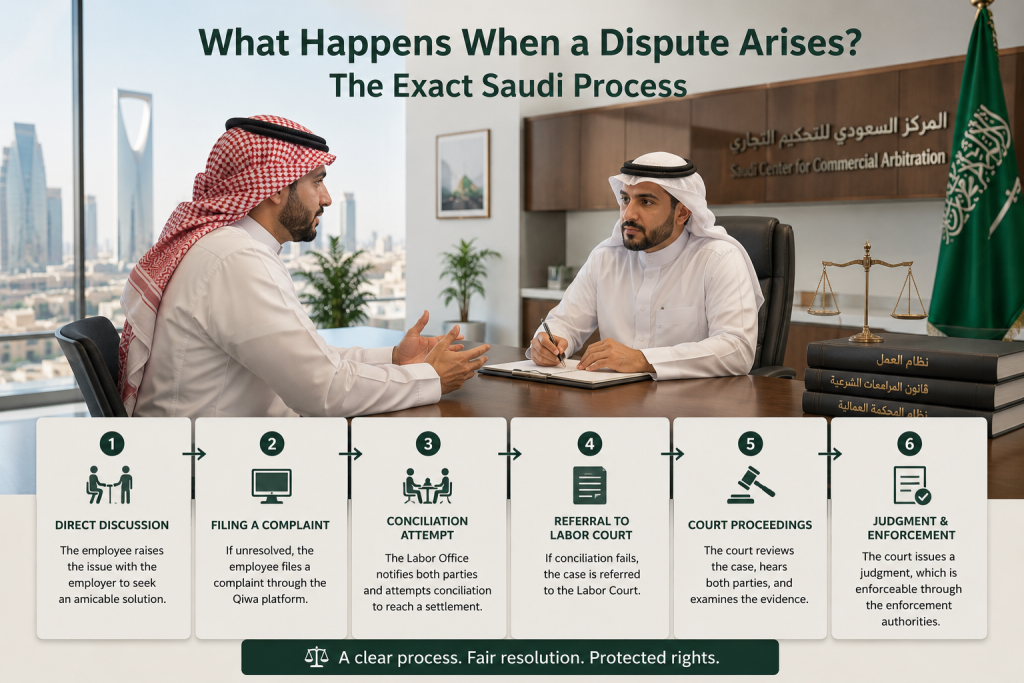
What Happens When a Dispute Arises? The Exact Saudi Process
Stage 1 MHRSD Amicable Settlement
12. The employee (or employer) files a claim electronically through the MHRSD’s Friendly Settlement portal. The claim is filed with the office that has jurisdiction over the area where the workplace is located.
13. The Amicable Settlement Department notifies both parties and schedules up to two sessions within 21 working days from the date of the first session.
14. Sessions aim to mediate a mutually acceptable resolution. If the defendant employer does not attend the first session, MHRSD suspends that employer’s services and schedules a second session.
15. If the defendant’s absence continues, the employee may transfer services to another employer without consent, and the case is referred to the labor court.
16. If settlement is reached, a signed settlement record is drawn up and is enforceable. If no agreement is reached after 21 working days, the case is submitted electronically to the Labor Court.
Stage 2 Labor Court
17. The case is filed electronically through the Najiz portal. Both parties receive a case reference number for tracking.
18. The labor court prepares a case file from MHRSD referral documents, employment contracts, and evidence submitted by both parties.
19. Statistics from the Ministry of Justice show that over 30% of labor cases are resolved at the first hearing session and around 40% at the second. The majority of cases are resolved within three sessions.
20. Judgments are issued in Arabic. Appeals are filed through the Najiz portal to the Court of Appeal. The appellant must submit a written brief stating the grounds for appeal.
Evidence Employers Must Have Ready
• The Qiwa-registered employment contract courts compare this to the version the employer presents
• Payroll records and monthly payslips WPS transaction records
• Attendance and time-tracking records critical for overtime and absence-related claims
• Written disciplinary warnings, investigation records, and the employee’s written responses
• Performance evaluation records and objectives set during probation
• Email and WhatsApp communications relating to job duties, salary, or termination
• Leave requests and approval records
• EOSB calculation sheets and final settlement documentation
How to Reduce Liability Before Termination
21. Build a written warning trail: Every disciplinary action must be documented in writing. Verbal warnings do not exist in Saudi labor court only written ones count.
22. Apply policies consistently: If one employee is given a warning for an action, all employees must receive the same treatment for the same action. Inconsistent enforcement is a red flag in labor court and undermines the employer’s credibility.
23. Document performance issues continuously: Do not wait until termination is decided to begin paperwork. Performance concerns should be reflected in formal evaluations, email communications, and written improvement plans from the moment they arise.
24. Align the contract and employee handbook: If the employment contract refers to company policies, those policies must be documented, accessible, and signed by the employee. Policies that exist only on a shared drive but were never acknowledged by the employee are difficult to rely on in court.
25. Review the Qiwa-registered contract before taking action: The version of the contract registered on Qiwa is the legally binding version. Ensure your internal HR records and the Qiwa records match before any termination or disciplinary action.
26. Run the EOSB calculation before the final conversation: Errors in EOSB are the most common post-termination dispute. Calculate the entitlement, cross-check against the actual wage definition, and prepare a written settlement statement ready for signature at the exit meeting.
27. Preserve digital records: WhatsApp messages, emails, and attendance system logs are regularly used as evidence in Saudi labor courts. Ensure your IT systems retain relevant records for at least 5 years.

Saudi Labor Law Compliance Checklist for Employers
Complete this audit quarterly, or whenever significant changes occur in your workforce or in the law:
✅ All employment contracts are written, signed, and registered on the Qiwa platform
✅ Probation clause included in every contract, not exceeding 180 days total
✅ Contracts updated to reflect 2025 notice period requirements (60 days / 30 days)
✅ Maternity leave policy updated to 12 weeks (6 weeks after birth mandatory)
✅ Paternity leave policy added 3 days paid within 7 days of birth
✅ Bereavement leave updated to include sibling death entitlement
✅ Wage payments processed through WPS-compliant channels on time every month
✅ Monthly payslips issued, itemizing basic salary, allowances, and overtime separately
✅ Overtime calculated on actual wage (basic + all fixed allowances), not basic salary alone
✅ Annual leave records maintained with employee sign-off on scheduling
✅ EOSB calculation methodology reviewed and documented using the actual wage basis
✅ Disciplinary procedures documented in a signed employee handbook
✅ Article 80 investigation procedure built into HR policy for serious misconduct cases
✅ Employee records (contracts, payslips, attendance, evaluations) retained for at least 5 years
✅ HR team trained on the 2025 amendments and updated processes
✅ Nitaqat color zone monitored regularly through the Qiwa portal
Frequently Asked Questions
Q1: What are the most common labor disputes in Saudi Arabia?
The most common labor disputes involve unpaid or delayed wages (monitored through the Wage Protection System), overtime payment shortfalls, wrongful termination claims, incorrect EOSB calculations, and employment contract violations. Leave disputes particularly relating to the 2025 maternity leave expansion are also increasingly common.
Q2: What is the probation period under Saudi Labor Law?
The probation period cannot exceed 180 days in total. It must be explicitly stated in the written employment contract a verbal probation arrangement has no legal effect. The same role cannot be subjected to multiple probation periods unless at least six months have passed since the previous employment ended. During probation, either party may terminate without notice and without EOSB.
Q3: How is overtime calculated in Saudi Arabia?
Under Article 107 of the Saudi Labor Law, overtime is calculated as one hour of the employee’s actual wage plus 50% of the basic hourly wage. The ‘actual wage’ includes basic salary and all fixed regular allowances not basic salary alone. All hours worked on official holidays and public vacations are treated as overtime. Employers may alternatively agree in writing to grant compensatory time off instead of overtime pay.
Q4: What is the labor dispute process in Saudi Arabia before court?
The process starts with an electronic complaint filed through the MHRSD’s Friendly Settlement portal. The Amicable Settlement Department schedules up to two sessions within 21 working days. If no settlement is reached within this period, the case is submitted electronically to the Labor Court and both parties receive a reference number to track the case through the Najiz portal.
Q5: When can an employer terminate an employee in Saudi Arabia?
An employer may terminate an indefinite contract by giving 60 days written notice. For serious misconduct under Article 80, termination without notice is permitted but only after a documented investigation in which the employee has been given a written opportunity to respond. Bankruptcy (declared by court) has been added as a lawful termination ground under the 2025 amendments.
Q6: How are end-of-service benefits calculated in Saudi Arabia?
EOSB is calculated under Article 84 using the employee’s actual wage (basic salary plus all fixed regular allowances). The formula is: half a month’s actual wage for each of the first five years of service, and one full month’s actual wage for each subsequent year. Fractions of a year are paid proportionally. If the employer terminates, EOSB must be paid within one week. If the employee resigns, it must be paid within two weeks.
Q7: What happens if an employee files a labor complaint in Saudi Arabia?
The MHRSD registers the complaint electronically and notifies the employer. If the employer does not attend the amicable settlement sessions, MHRSD suspends the employer’s services including visa processing and the case is referred directly to the labor court. The employee may also transfer to another employer without the non-compliant employer’s consent.
Q8: What records should employers keep to defend against labor claims?
Employers should retain: Qiwa-registered employment contracts, monthly payslips with WPS transaction records, attendance and time-tracking logs, written disciplinary warnings and investigation records, performance evaluation documents, email and WhatsApp communications related to employment matters, leave request and approval records, and EOSB calculation sheets. Records should be retained for at least 5 years.
Q9: What role do Qiwa and Najiz play in labor compliance and disputes?
Qiwa is the MHRSD’s digital platform for registering employment contracts, managing Saudization (Nitaqat) data, processing visa applications, and monitoring WPS compliance. All employment contracts must be registered on Qiwa. Najiz is the Ministry of Justice’s portal for filing and tracking labor court cases electronically once the amicable settlement stage is complete.
Q10: Can an employer change an employee’s contract terms in Saudi Arabia?
No. The work type and contractual terms cannot be changed without the worker’s written consent. Unilateral changes to job title, duties, location, or compensation constitute a breach of contract. If an employer imposes a material unilateral change, the employee may treat it as constructive dismissal and file a labor dispute.
Conclusion: Protecting the Enterprise Through Proactive Compliance
Saudi labor law has fundamentally changed in 2025. New leave entitlements, clearer termination procedures, stronger Nitaqat enforcement, and digitally monitored wage payment obligations have all raised the compliance threshold for every private-sector employer in the Kingdom.
The four principles that protect businesses from labor disputes are simple to state and difficult to maintain without discipline: prevention is cheaper than litigation; documentation is the employer’s strongest defense in any Saudi labor court; compliance with the WPS, Qiwa, and Nitaqat systems protects business continuity; and regular legal reviews catch problems before they become claims.
Alkhorayef Law Firm advises businesses operating in Saudi Arabia on employment contracts, HR policy alignment with the 2025 labor law amendments, disciplinary procedures, termination risk management, and labor dispute representation. Contact us before a dispute arises, not after.