A power of attorney (POA) is one of the most useful legal tools in the Kingdom. It lets you appoint someone you trust to act for you to sign documents, manage money, sell property, or run a company when you cannot be there in person. If you want to know how to get power of attorney in Saudi Arabia, this guide explains everything in simple language. At AlKhorayef Law Firm, we draft, notarize, and manage powers of attorney for residents, expats, and companies every day, and we will walk you through each step.
What Is a Power of Attorney?
A power of attorney, known in Arabic as a wakala, is a legal document in which one person (the principal) gives another person (the agent) the authority to act on their behalf. It is governed by Sharia principles and the Notarization Law (Royal Decree No. M/26). To be valid, a POA must be in writing, clearly state the powers granted, and be notarized by an authorized notary. People use a POA for many reasons, from handling a single sale to managing a full business. Understanding how legal advice protects your business often starts with getting your POA right.
General vs Special Power of Attorney: The Difference
Many clients ask us about the general vs special power of attorney Saudi Arabia difference. The two are not the same, and choosing the wrong one can cause problems.
A general power of attorney gives the agent broad authority. The agent can manage your finances, sign contracts, buy or sell property, and handle business matters. It suits long-term needs, such as running a company while you are abroad.
A special power of attorney is limited to one task or matter, such as selling a specific property or completing a single transaction. It usually ends once the task is finished. We often recommend a special POA because it lowers risk by limiting what the agent can do. A corporate lawyer in Saudi Arabia can help you pick the right type for your goals.
How to Get a Power of Attorney in Saudi Arabia
The easiest way today is online. The power of attorney Saudi Arabia Najiz platform online service, run by the Ministry of Justice, lets you create and issue a POA from home in minutes, with no court visit. Here is how the Najiz process works:
- Log in to the Najiz portal using your National Single Sign-On (through Absher or Nafath).
- Open “All Electronic Services,” then choose “Powers of Attorney and Declarations.”
- Select “Issue individual power of attorney” and start a new application.
- Enter the details of the principal and the agent exactly as registered on their ID or Iqama.
- Choose the specific powers (the terms) and set the validity period.
- Approve and submit. The Virtual Notary Public issues and certifies the POA electronically.
Once issued, the POA is registered with the Ministry of Justice. Government bodies and most banks accept and verify it electronically. If you prefer, you can also visit an authorized notary public (Kateb Adl) in person. Either way, our team makes sure the wording protects you.
Saudi Arabia POA Notarization Requirements 2025
The Saudi Arabia POA notarization requirements 2025 introduced still apply today. To be legally valid, a POA must be:
- In writing and clearly drafted, listing each power granted.
- Written in Arabic. If your document is in English, it must be officially translated.
- Notarized, either electronically through the Najiz virtual notary or in person at a notary office.
- Issued with verified identity for both the principal and the agent.
Correct notarization is the step most people get wrong. Our notary services in Saudi Arabia make sure your POA is accepted the first time, without delays or rejections.
Power of Attorney for Expats: Documents You Need
Expats living in the Kingdom can issue a POA just like citizens. The power of attorney for expat in Saudi Arabia documents you need are simple:
- A valid Iqama (residence permit) for the principal.
- An active Absher or Nafath account for digital verification.
- A valid national ID or Iqama for the agent.
- A passport copy may be needed in some cases.
Because the whole process is digital, expats can issue a POA in minutes through Najiz. This is helpful for tasks like managing a lease, handling banking, or representing heirs. For estate matters, see our guide on inheritance and wills for families and expats. Skipping legal advice here is one of the common legal mistakes foreign investors make.
How to Authenticate a Power of Attorney at a Saudi Embassy Abroad
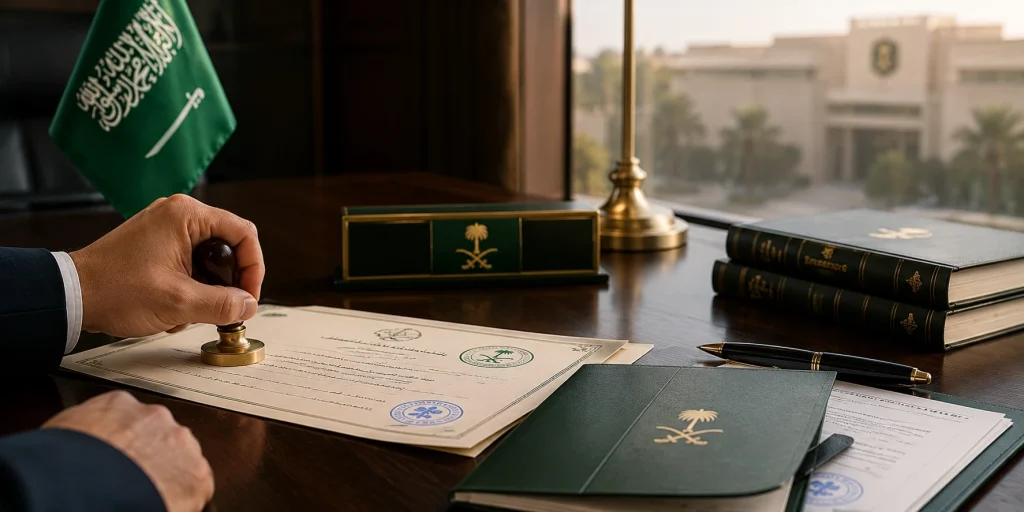
If you are outside the Kingdom, you may need to know how to authenticate power of attorney Saudi embassy abroad rules. A POA signed in another country must be legalized before Saudi authorities will accept it. The usual steps are:
- Notarize the POA before a notary public in the country where you sign it.
- Authenticate it through that country’s foreign ministry or relevant authority.
- Legalize it at the Saudi embassy or consulate in that country.
- Attest it at the Ministry of Foreign Affairs (MOFA) after it reaches the Kingdom.
- Translate it into Arabic by a certified translator.
Since December 2022, Saudi Arabia is a member of the Hague Apostille Convention. So for documents from other member states, an apostille can often replace full embassy legalization, which saves time. Where the apostille route is not available, the traditional steps above apply. Saudi nationals and residents abroad can also issue a POA directly through Saudi embassies and consulates.
Power of Attorney for Property Sale
A very common need is a power of attorney for property sale Saudi Arabia owners want to handle remotely. If you cannot attend the sale in person, a special POA lets your trusted agent sign the sale, transfer the title, and complete the deal for you. The POA must clearly identify the property and the exact powers granted, and it must be notarized. Because property deals carry high value and risk, we recommend careful drafting. Our attorney services for real estate cover POAs for buying, selling, and managing property.
Power of Attorney for Business and Company Registration
A POA is also essential for business. The power of attorney business company registration Saudi Arabia route lets a foreign investor or busy owner appoint an agent to register a company, sign the Articles of Association, open a corporate bank account, and deal with the Ministry of Investment and the Ministry of Commerce. This means you do not have to be present in the Kingdom to set up your business. We explain the full process in our guide on how to set up a company in Saudi Arabia, and we can also manage your assets through our asset management services.
Validity Period and Expiry Rules
It is important to understand POA Saudi Arabia validity period expiry rules. When you issue a POA, you can set a clear start date and expiry date. If you do not set one, special limits may apply for example, powers of attorney given to legal advisers are generally treated as valid for five years from the date of issue, unless an earlier end date is stated or the POA is revoked.
Remember that Saudi Arabia uses the Hijri calendar, which is about 10 to 12 days shorter than the Gregorian year, so a five-year POA may expire sooner than you expect. A POA also ends when the task is complete, when it is revoked, or on the death of the principal. We help clients track these dates so authority never lapses at the wrong moment. If a dispute arises, our litigation services in Saudi Arabia team can step in.
How to Revoke or Cancel a Power of Attorney
You are always in control. To revoke power of attorney Saudi Arabia how to cancel questions have a simple answer: the principal can cancel a POA at any time. You can revoke it online through Najiz using the cancellation service, or through a notary. After cancelling, you should inform the agent and any banks or bodies that relied on the POA, so no one acts on outdated authority. We handle revocations cleanly to protect you from misuse.
How AlKhorayef Law Firm Can Help
At AlKhorayef Law Firm, we draft, notarize, authenticate, and revoke powers of attorney for individuals, expats, and companies. We make sure the scope is right, the wording is clear, and the document is accepted by every authority. Whether you need a POA for property, business, or family matters, we manage the full process for you. Explore our full range of legal services in Saudi Arabia, learn more about our firm, or contact us to issue your power of attorney today.

Frequently Asked Questions (FAQs)
1. How Do I Get a Power of Attorney in Saudi Arabia?
The easiest way is online through the Najiz platform. You log in with Absher or Nafath, choose “Powers of Attorney and Declarations,” enter the principal and agent details, select the powers and duration, and the Virtual Notary issues it electronically. You can also visit a notary in person.
2. Can I Issue a Power of Attorney Online Through Najiz?
Yes. The Najiz platform by the Ministry of Justice lets residents and citizens issue a POA in minutes, with no court visit. The document is registered electronically and accepted by government bodies and most banks.
3. What Is the Difference Between a General and Special Power of Attorney?
A general POA grants broad authority over finances, contracts, property, and business. A special POA is limited to one task, such as selling a specific property, and usually ends when that task is complete.
4. How Long Is a Power of Attorney Valid in Saudi Arabia?
You can set your own expiry date when issuing the POA. If none is set, certain POAs, such as those given to legal advisers, are generally valid for five Hijri years. The Hijri year is shorter than the Gregorian year, so plan accordingly.
5. How Do I Revoke or Cancel a Power of Attorney?
The principal can revoke a POA at any time, either online through Najiz or at a notary office. After cancelling, you should notify the agent and any banks or authorities that relied on it.
6. What Documents Does an Expat Need for a Power of Attorney?
An expat needs a valid Iqama, an active Absher or Nafath account, and the agent’s valid national ID or Iqama. A passport copy may also be required in some cases. The process is fully digital through Najiz.
7. How Do I Authenticate a Power of Attorney at a Saudi Embassy Abroad?
A POA signed abroad must be notarized, authenticated by the local foreign ministry, then legalized by the Saudi embassy and attested by MOFA in the Kingdom. For Hague Apostille member states, an apostille can often replace embassy legalization. All documents must be translated into Arabic.
8. Can I Use a Power of Attorney to Sell Property in Saudi Arabia?
Yes. A special power of attorney lets your agent sign the sale, transfer the title, and complete a property deal on your behalf. The POA must clearly identify the property and be properly notarized.
This article is for general information only and does not replace legal advice. For guidance on your specific situation, please contact AlKhorayef Law Firm.