Saudi Arabia is one of the fastest-growing business markets in the world, and more investors are entering the Kingdom every month. If you are planning company registration Saudi Arabia 2026, it is important to understand the legal steps before you start. The rules have changed a lot under Vision 2030, and getting the process right from day one saves you time, money, and stress. At AlKhorayef Law Firm, we guide local founders and foreign investors through every stage of setting up a business in the Kingdom. In this guide, we explain the legal requirements, the documents you need, the timelines, and the compliance rules that apply once your company is live.
Why 2026 Is a Strong Year to Set Up a Business
Thanks to Vision 2030 reforms, Saudi Arabia has opened most of its economy to foreign investors. Today, 100% foreign ownership Saudi Arabia business 2026 is allowed in many sectors, including consulting, IT, manufacturing, wholesale, and retail. You no longer need a local Saudi partner for most activities, and foreign investors now enjoy equal legal treatment with Saudi nationals, including full profit repatriation.
A few sectors are still restricted or sit on a “negative list,” such as media, defense, oil and gas, and certain real estate activities in Makkah and Madinah. Some regulated sectors also need extra approvals for example, the Saudi Central Bank (SAMA) for banking, the Capital Market Authority (CMA) for financial services, and the SFDA for health and food products. We always check your activity against the current rules first, because choosing the wrong classification is one of the common legal mistakes foreign investors make.
Choosing the Right Legal Structure
Before registration, you must pick a legal structure. The most common choice is the Limited Liability Company (LLC), because it is flexible and protects your personal assets. Under the new Companies Law, an LLC can be formed with a single shareholder (a One-Person LLC) and up to 50 partners.
If you are wondering how to register LLC in Saudi Arabia, the path depends on who you are. Saudi and GCC nationals begin directly with commercial registration. Foreign investors must first get an investment license from the Ministry of Investment (MISA), then move to the commercial registration step. Other structures include a branch of a foreign company and a Regional Headquarters (RHQ) for multinationals that want a Gulf hub in Riyadh. Our corporate lawyers in Saudi Arabia help you select the structure that fits your goals, your sector, and your long-term plans.
MISA Investment License Requirements for Foreigners
For non-Saudi investors, the MISA investment license requirements foreigners must meet are the first real step. The MISA license (now often called the Investment Registration Certificate) is the official approval that lets a foreign company operate legally and then issue its commercial registration.
To apply, you will usually need:
- A copy of your parent company’s commercial registration and Articles of Association
- Audited financial statements (often for the last year or two)
- Passport copies of shareholders and authorized representatives
- A clear business plan and your chosen activity codes
All foreign documents must be translated into Arabic, notarized, and attested by the Saudi Embassy in your home country and the Ministry of Foreign Affairs (MOFA) in the Kingdom. Once your paperwork is complete, MISA usually issues the license within about 3 to 5 business days for standard activities, though complex cases can take longer. Good news for 2026: many MISA issuance fees remain suspended to encourage new investment. Because document attestation is strict, working with a commercial lawyer in Saudi Arabia helps you avoid rejection and delays.
Minimum Capital Requirement for a Company in Saudi Arabia
A common question we hear is about the minimum capital requirement company Saudi Arabia rules. Under the new Companies Law, there is no fixed statutory minimum capital for an LLC owned by Saudi or GCC investors. The law only asks that the capital be “sufficient to achieve the company’s objective.”
For foreign investors, capital depends on the activity, based on MISA’s tables. In practice, service-based LLCs often start around SAR 100,000 to SAR 500,000. A 100% foreign-owned trading or wholesale-retail business faces a much higher floor around SAR 30 million and may need to operate in several international markets. Industrial licenses often require SAR 1 million or more, while a branch typically needs around SAR 25,000. You do not pay the full capital on day one. The corporate bank account is opened only after your commercial registration, national address, and General Manager’s residency (Iqama) are in place. We help you plan capital in a way that protects your visa quotas and banking credibility.
Saudi Arabia Commercial Registration (CR) Process Steps
After the MISA license, you move to commercial registration. The Saudi Arabia commercial registration CR process steps are now mostly digital and unified. This is where the Saudi Business Center company setup guide becomes useful, because the Saudi Business Center (SBC) acts as the single online platform for company formation. Our simple breakdown of how to set up a company in Saudi Arabia walks through each step in plain language.
Here are the main steps:
- Reserve your trade name through the Saudi Business Center. The same name must match your MISA license, your Articles of Association, and your CR.
- Draft and notarize the Articles of Association, which set out ownership, management, and capital. In 2026, this is done electronically through the Ministry of Justice.
- Issue the Commercial Registration through the Ministry of Commerce. Your CR gives you a unique number and a Unified National Number, which is the key for all future government services.
- Pay the official fees, such as the CR fee and a publication fee, plus VAT.
- Register your physical office address, with the lease recorded in the Ejar system.
Notarization is a critical part of this stage. If you need documents certified correctly, our notary services in Saudi Arabia make sure everything is valid and accepted.
Post-Registration Compliance: VAT, GOSI, and Saudization
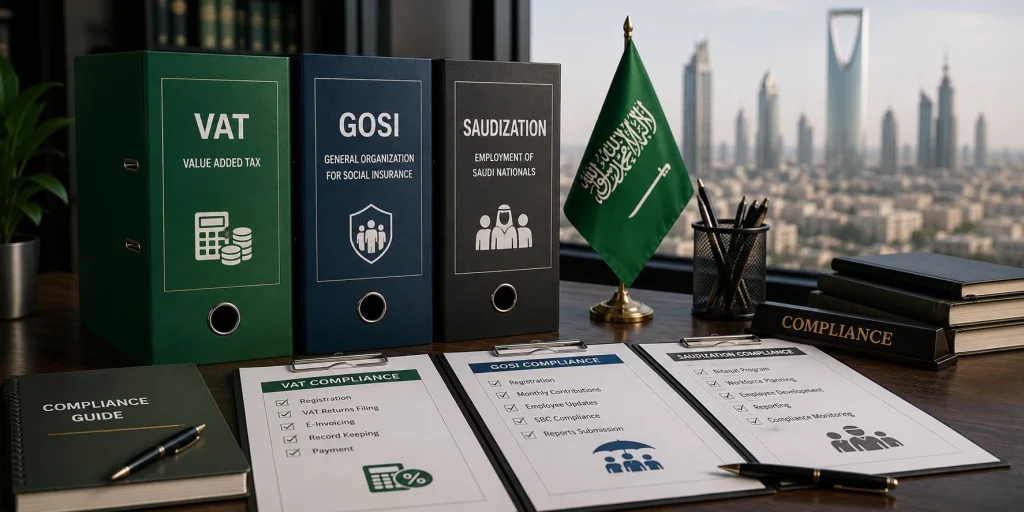
Getting your CR is not the end. Several registrations follow, and missing them can lead to penalties. We help clients understand how legal advice protects your business during this stage.
ZATCA VAT registration new business Saudi Arabia rules are a key step. You must register for VAT with the Zakat, Tax and Customs Authority (ZATCA) once your taxable sales pass SAR 375,000 in any 12-month period. Registration is voluntary between SAR 187,500 and SAR 375,000. You have 30 days to register after crossing the threshold, and late registration carries a SAR 10,000 penalty. The standard VAT rate is 15%, and e-invoicing through the Fatoora system is now mandatory.
Next come Nitaqat Saudization requirements new company owners must follow. Saudization is managed by the Ministry of Human Resources (MHRSD) through the Qiwa platform. Companies are graded into colored bands Platinum, High Green, Mid Green, Low Green, and Red (the old Yellow band is gone). Small companies with five or fewer staff usually need at least one Saudi national to stay in the green zone, and for foreign companies the second hire after the General Manager should be Saudi. As of April 2026, a Saudi employee only counts toward your quota if their contract is documented on Qiwa, and the minimum monthly wage to count rose to SAR 4,000. Some professions have higher targets, such as engineering and marketing. Strong Saudization keeps your visas and services open, which is why we also advise on Saudi labor law compliance. You will also register with GOSI for social insurance and set up the Wage Protection System.
How Long Does Company Registration Take in Saudi Arabia?
Many clients ask, how long does company registration take Saudi Arabia? For Saudi and GCC nationals, the core registration can be done in just a few business days. For foreign investors, the full setup usually takes around two months, mostly because of the MISA license, document attestation, and the time needed to open a corporate bank account. When your documents are prepared correctly from the start, the timeline is much shorter. Our team also supports growing businesses with asset management services and dispute matters through our litigation services once they are operating.
How AlKhorayef Law Firm Can Help
At AlKhorayef Law Firm, we manage the full journey for you from the MISA license and trade name reservation to your CR, VAT, and Saudization setup. We prepare and attest your documents, handle Arabic translation, and make sure your structure meets Saudi law. You focus on your business; we handle the legal details. You can learn more about our full range of legal services, read about our team and values, or contact us to start your company registration today.

Frequently Asked Questions (FAQs)
1. How Long Does Company Registration Take in Saudi Arabia?
For Saudi and GCC investors, registration can take only a few business days. For foreign investors, it usually takes around two months, mainly because of the MISA license and bank account steps. With correct documents, the process is faster.
2. Can a Foreigner Own 100% of a Company in Saudi Arabia?
Yes. In most sectors, foreign investors can own 100% of their company without a local partner. However, some regulated sectors and a small negative list still have ownership limits or need special approvals.
3. What Is the Minimum Capital Requirement for a Company in Saudi Arabia?
There is no fixed statutory minimum for an LLC under the new Companies Law for Saudi and GCC owners. For foreign investors, the amount depends on the activity, ranging from about SAR 100,000 for many service businesses to SAR 30 million for some trading activities.
4. Do I Need a MISA Investment License Before Registering My Company?
Yes, if you are a foreign investor. The MISA license is the first step and is required before you can issue your commercial registration. Saudi and GCC nationals can skip MISA and begin directly with the CR.
5. When Must a New Business Register for ZATCA VAT in Saudi Arabia?
A business must register for VAT once its taxable sales pass SAR 375,000 in a 12-month period. Registration is voluntary between SAR 187,500 and SAR 375,000. You must register within 30 days to avoid a SAR 10,000 penalty.
6. What Are the Nitaqat Saudization Requirements for a New Company?
New companies must hire Saudi nationals based on their size and sector. Small businesses with five or fewer staff usually need at least one Saudi employee, and contracts must be documented on the Qiwa platform to count toward your quota.
7. What Documents Are Needed to Register an LLC in Saudi Arabia?
You typically need the parent company’s commercial registration and Articles of Association, audited financial statements, passport copies of shareholders, a notarized Memorandum and Articles of Association, and a registered office lease. Foreign documents must be translated into Arabic and attested.
8. Can I Register My Company Online Through the Saudi Business Center?
Yes. The Saudi Business Center is the unified digital platform where you reserve your trade name, notarize your documents, and issue your commercial registration. Most steps can now be completed online.
This article is for general information only and does not replace legal advice. For guidance on your specific situation, please contact AlKhorayef Law Firm.