A contract is only as strong as the clauses inside it. In the Kingdom, a clause that works perfectly in London or Dubai can be reduced or thrown out by a Saudi court because it does not fit local rules. If you sign deals regularly but do not have an in-house legal team, this guide is for you. Below are the must have clauses in Saudi Arabia contracts, written in plain English, with a short note on why each one matters and what to avoid. Our team drafts and reviews these contract clauses for Saudi Arabia business every day, and getting them right before you sign saves a great deal of money later.
1. Dispute Resolution Clause
This is the most important clause in any deal. A Saudi Arabia contract dispute resolution clause decides where and how a fight will be settled. You have two main choices: the Saudi courts or arbitration.
Many businesses now choose arbitration through the Saudi Center for Commercial Arbitration. A clear SCCA arbitration clause template Saudi Arabia names the SCCA, sets the seat, the language, and the number of arbitrators. Arbitration is often faster and more private than court, and awards are easier to enforce across borders. So yes can I include arbitration instead of court in a Saudi contract? you can, and for commercial deals it is frequently the smarter option.
When a dispute crosses borders, the enforcement side becomes critical. Our guide on enforcing a foreign debt or judgment in Saudi Arabia explains what happens when the other side will not pay, and our litigation services and enforcement services handle both routes.
Why Your Dispute Resolution Clause Needs to Change in 2026
Here is a timely point most contracts miss. An arbitration clause Saudi Arabia 2026 should account for reform that is already underway. On 24 September 2025, the Kingdom published a Draft Arbitration Law for public consultation, proposing major changes to party autonomy on governing law, annulment grounds, and emergency arbitration. The current framework still rests on the 2012 Arbitration Law, but the direction of travel is clear. Any contract signed now should use a clause that is ready for the new regime, not the old one.
2. Governing Law Clause
A governing law clause Saudi Arabia contract states which country’s law applies. Businesses often ask, can a Saudi contract use foreign governing law? In principle yes, but with real limits. If a dispute is heard before the Saudi courts, the court will generally apply Saudi law and will not give effect to anything that conflicts with Sharia or public order no matter what the clause says. Foreign law has more room to operate inside arbitration than in court. So choose your governing law and your dispute forum together, not separately.
3. Payment and No-Interest (Riba) Clause
This clause catches many foreign businesses by surprise. A Saudi contract riba clause interest prohibition issue arises because interest (riba) is prohibited under Islamic law. Is an interest clause enforceable in Saudi Arabia? No. A Saudi court will not enforce an interest charge, even if both sides agreed to it. If you need to protect against late payment, use lawful tools instead a clear payment schedule, milestones, suspension rights, or a properly drafted liquidated damages clause. Drafting the payment terms well is part of how legal advice protects your business in Saudi Arabia.
4. Liquidated Damages Clause
A Saudi Arabia liquidated damages clause enforceable question comes up in almost every construction and supply contract. The good news is that these clauses are allowed. The catch is that a Saudi court can adjust the figure to match the actual loss suffered. A clause that looks like a punishment, far above any real damage, will be reduced. So set a number that genuinely reflects the harm a breach would cause, and keep evidence of how you calculated it.
5. Limitation of Liability Clause
A limitation of liability clause Saudi Arabia can cap how much one party must pay if things go wrong. These are generally accepted when drafted reasonably and tied to foreseeable loss. What a court will not accept is a clause that tries to escape liability for gross negligence or deliberate wrongdoing. Keep the cap fair and specific, and it will usually hold.
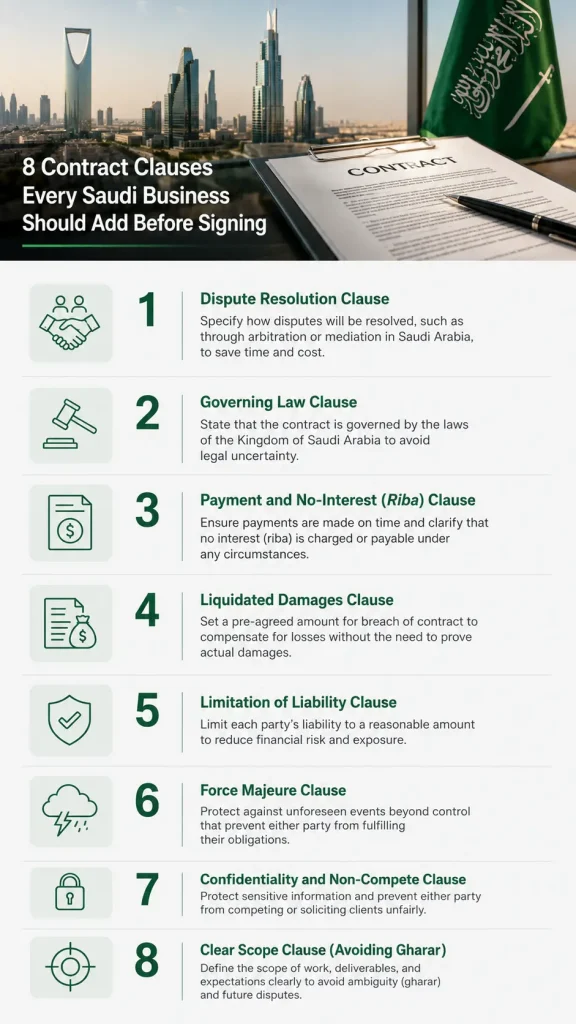
6. Force Majeure Clause
A Saudi Arabia force majeure clause protects you when something outside your control a natural disaster, a government order, a pandemic makes performance impossible. List the events clearly, state what happens to obligations and timelines, and explain the notice each side must give. A vague force majeure clause is one of the most common weaknesses we see when reviewing contracts.
7. Confidentiality and Non-Compete Clause
This clause protects your business secrets and your client relationships, and it matters in both commercial and employment deals. A confidentiality clause Saudi Arabia employment can run for any reasonable period, since the law sets no fixed limit on confidentiality.
Non-compete is stricter. Does Saudi Arabia enforce non-compete clauses? Yes, but under tight rules. The Saudi Arabia non-compete clause rules sit in Article 83 of the Labour Law: the restriction must be in writing, limited to a specific type of work, limited to a defined area, and may last no more than two years after the job ends. A broad “you can never work in this field anywhere” clause will be struck down. For more on staff matters, see our guide to Saudi labor law compliance and employee disputes.
Qiwa Authenticated Contracts: The August 2026 Deadline
If you employ staff, you also need to know about Qiwa contract clauses employer 2026. Saudi Arabia is moving all employment contracts onto digitally authenticated Qiwa contracts, which are now enforceable instruments. The change is phased: new contracts since October 2025, existing fixed-term contracts by March 2026, and existing open-ended contracts by 6 August 2026. Employers can add custom clauses on top of the standard Qiwa wording, but those clauses must respect the same limits including the two-year non-compete cap. Aligning your contracts before the deadline avoids penalties.
8. Clear Scope Clause (Avoiding Gharar)
The final clause is about clarity itself. Under Sharia, a contract with excessive uncertainty can fail this is the gharar clause Saudi Arabia contract void risk. If the price, the quantity, the timeline, or the deliverable is too vague, a court may treat the deal as defective. So define the scope of work, the price, and the dates precisely. Clear drafting is not just good practice here; it is a legal requirement.
A quick related point: do I need a written contract in Saudi Arabia? While some agreements can be oral, a clear written contract is far safer and is often required to prove your case. And under the Kingdom’s Electronic Transactions Law, a properly executed Saudi Arabia electronic contract validity is recognised a digital contract can be legally binding.
A Note for Specific Sectors
If you work with a local distributor or agent, add a carefully drafted Saudi Arabia commercial agency termination clause. The agency rules are strict, and ending a registered agency without the right terms can expose you to compensation claims. This is a frequent entry on our list of common legal mistakes foreign investors make in Saudi Arabia. Family businesses should also consider succession terms, which connect to the rules in our inheritance and wills guide.
How We Help
Before you sign anything, let us check it. As your commercial lawyer in Saudi Arabia and corporate lawyer, we draft these clauses so they hold up under Saudi law, authenticate documents through our notary services, and support you whether you are signing a single deal or setting up a company in Saudi Arabia. You can view our full legal services or contact us for a review before you sign.

Frequently Asked Questions
1. Can A Saudi Contract Use Foreign Governing Law?
Yes, in principle, but with limits. If the dispute is heard by a Saudi court, the court will generally apply Saudi law and will not enforce anything that conflicts with Sharia or public order, regardless of the clause. Foreign governing law has more effect inside arbitration than in the Saudi courts, so choose your governing law and your dispute forum together.
2. Is An Interest Clause Enforceable In Saudi Arabia?
No. Interest is treated as riba and is prohibited under Islamic law, so a Saudi court will not enforce it even if both parties agreed. To protect against late or non-payment, use lawful tools such as clear payment milestones, suspension rights, and a properly drafted liquidated damages clause instead.
3. What Happens If A Contract Clause Conflicts With Sharia?
A clause that conflicts with Sharia or public order will not be enforced. In many cases the court strikes out only the offending clause and keeps the rest of the contract, but a core defect such as excessive uncertainty (gharar) can undermine the whole agreement. This is why local legal review before signing matters.
4. Does Saudi Arabia Enforce Non-Compete Clauses?
Yes, but under strict conditions set in Article 83 of the Labour Law. The clause must be in writing, limited to a specific type of work, limited to a defined geographic area, and last no longer than two years after employment ends. A clause that is too broad will be ruled unenforceable.
5. What Is The SCCA And Should I Use It In My Contract?
The SCCA is the Saudi Center for Commercial Arbitration, an independent institution that administers arbitration under its own rules. Naming the SCCA in your dispute resolution clause gives you a clear, recognised forum that is often faster and more private than court, and its awards are easier to enforce. For most commercial contracts, it is worth considering.
6. Do I Need A Written Contract In Saudi Arabia?
While some agreements can be oral, a clear written contract is strongly advised and is often needed to prove your case. Many obligations such as a valid non-compete must be in writing to be enforceable. A written contract reduces disputes and protects both sides.
7. Can I Include Arbitration Instead Of Court In A Saudi Contract?
Yes. Saudi law recognises arbitration agreements, and you can name an institution such as the SCCA in your contract. A good arbitration clause sets the seat, the language, the rules, and the number of arbitrators. Given the arbitration reform underway in 2026, make sure your clause is drafted to suit the modern framework.