
Winning a court case abroad is only half the battle. If your debtor or their money sits inside the Kingdom, you still need a Saudi court to recognize and act on your ruling. To enforce foreign judgment Saudi Arabia 2026 rules apply, and these rules have just changed in a big way. At AlKhorayef Law Firm, we help local and international clients turn a paper judgment into real recovery. In this guide, we explain the new law, the reciprocity test, the documents you need, and the exact steps to follow at the execution court all in simple language.
The New 2026 Enforcement Law (Royal Decree M/237)
Saudi Arabia issued a new Enforcement Law in 2026 under Royal Decree No. M/237, dated 3/11/1447H (20 April 2026). It replaces the older 2012 Enforcement Law (Royal Decree No. M/53) and comes into full force 180 days after it was published in the Official Gazette, around late October 2026. The new law modernizes the whole system, widens the list of enforceable documents, and gives execution judges stronger tools to trace and seize assets. We break down the wider reforms in our guide to Saudi Arabia’s 2026 Enforcement Law (Royal Decree M/237).
The most important point for cross-border creditors is this: the Saudi Arabia Enforcement Law Article 9 foreign judgments rules now sit in Article 9 of the new law. This article sets out when an execution court may treat a foreign judgment, order, or arbitral award as enforceable inside the Kingdom.
The Reciprocity Requirement
The first hurdle is reciprocity. The Saudi Arabia foreign judgment reciprocity requirement means the court must be satisfied that the country where your judgment was issued would also enforce a Saudi judgment in return. In practice, you need to show real proof of this such as a treaty between the two countries, past cases where that country enforced Saudi rulings, or an expert legal opinion from a lawyer in that country.
Getting this proof is often the hardest part. The Ministry of Justice may be asked to confirm reciprocity, and this can take time. Since 2026, judges have applied the test more strictly, looking for genuine, practical reciprocity rather than a simple promise. This is why early planning matters, and why we always assess reciprocity before filing. Skipping this check is one of the common legal mistakes foreign investors make.
Article 9: The Conditions for Enforcement
Even when reciprocity exists, the execution court must check several conditions before it stamps your judgment for enforcement. Under Article 9, the foreign judgment will only be enforced if:
- The dispute does not fall under the exclusive jurisdiction of Saudi courts.
- There is no earlier or identical case already filed in the Kingdom on the same matter.
- Both parties were properly notified, fairly represented, and given a real chance to defend themselves.
- The judgment is final and can no longer be appealed in the country where it was issued.
- The judgment does not clash with an earlier Saudi judgment on the same subject.
- The judgment does not break Saudi public order or Sharia principles.
These conditions protect fairness and Saudi sovereignty. Our litigation services team prepares your file to meet every point so the court has no reason to refuse.
Treaties That Make Enforcement Easier
Some judgments enjoy a faster path. The GCC convention enforce court judgment Saudi Arabia route applies to rulings from Gulf Cooperation Council states. Under the GCC Convention for the Execution of Judgments, a judgment issued in one member state is enforceable in the others, as long as it is enforceable in the country of origin. The GCC Convention even lists the documents you need: a certified copy of the judgment, a certificate showing it is final, and proof of service if it was a default judgment.
Saudi Arabia is also part of the Riyadh Arab Agreement for Judicial Cooperation, which covers many Arab League countries. These treaties remove much of the reciprocity burden, because the agreement itself proves the two states cooperate. For judgments from these regions, enforcement is usually smoother and quicker.
When a Foreign Judgment Is Not Enforceable
Not every ruling can be enforced, even with reciprocity. A foreign court judgment not enforceable Saudi Arabia Sharia situation happens when the judgment conflicts with Islamic law or Saudi public order. The clearest example is interest (riba). Saudi courts traditionally refuse to enforce the interest part of a judgment, although in some cases a court may allow amounts framed as compensation for delay rather than pure interest. This is fact-sensitive and needs careful drafting.
Other judgments that are usually not enforceable include rulings over Saudi real estate (in rem disputes), criminal and administrative judgments unless a treaty covers them, and any judgment that contradicts an earlier Saudi decision. We review your judgment early to flag these risks before you spend time and money filing.
Foreign Arbitral Awards and the New York Convention
Many people confuse a court judgment with an arbitration award, but the two follow different paths. The recognition foreign arbitral award Saudi Arabia New York Convention route is often easier than enforcing a court judgment. Saudi Arabia joined the 1958 New York Convention (with a reciprocity reservation), and Saudi courts have confirmed that a country being a member of the Convention is enough to satisfy reciprocity for arbitral awards.
This is good news. An award from a respected seat for example, an LCIA award issued in London is, in principle, enforceable in the Kingdom. The execution judge does not re-examine the merits of the dispute; the judge only checks that the conditions are met. You will need to submit the original award (or a certified copy), the arbitration agreement, and certified Arabic translations. Because arbitration offers a clearer route to recovery, we often advise clients on it through our enforcement services in Saudi Arabia in Saudi Arabia and broader debt collection in Saudi Arabia work.
Can I Enforce a UK Court Judgment in Saudi Arabia?
A common question we hear is, can I enforce UK court judgment in Saudi Arabia? The honest answer is that it is difficult but not impossible. Saudi Arabia has no bilateral treaty with the United Kingdom for the mutual enforcement of court judgments, so a UK judgment creditor must prove reciprocity on a case-by-case basis. That can be slow and uncertain.
However, if your UK dispute went through arbitration for instance, an award seated in London you can usually rely on the New York Convention, which makes recovery far more realistic. So the structure of your original case matters a great deal. Our work on B2B debt collection in Saudi Arabia in Saudi Arabia often starts with this exact analysis.
Apostille and Document Legalization
Your paperwork must be valid in the Kingdom before any court will act. The apostille Saudi Arabia foreign judgment documents question depends on where your documents come from. Saudi Arabia joined the Hague Apostille Convention, in force since December 2022, so documents from other member states can often be apostilled instead of going through full consular legalization.
Where the apostille route is not available, the traditional path applies: notarize the document, then have it authenticated by the foreign ministry in the issuing country, then legalized by the Saudi embassy or consulate, and finally attested in the Kingdom. In every case, foreign documents must be translated into Arabic by a licensed translator. Correct attestation is essential, and our notary services in Saudi Arabia make sure your documents are accepted the first time.
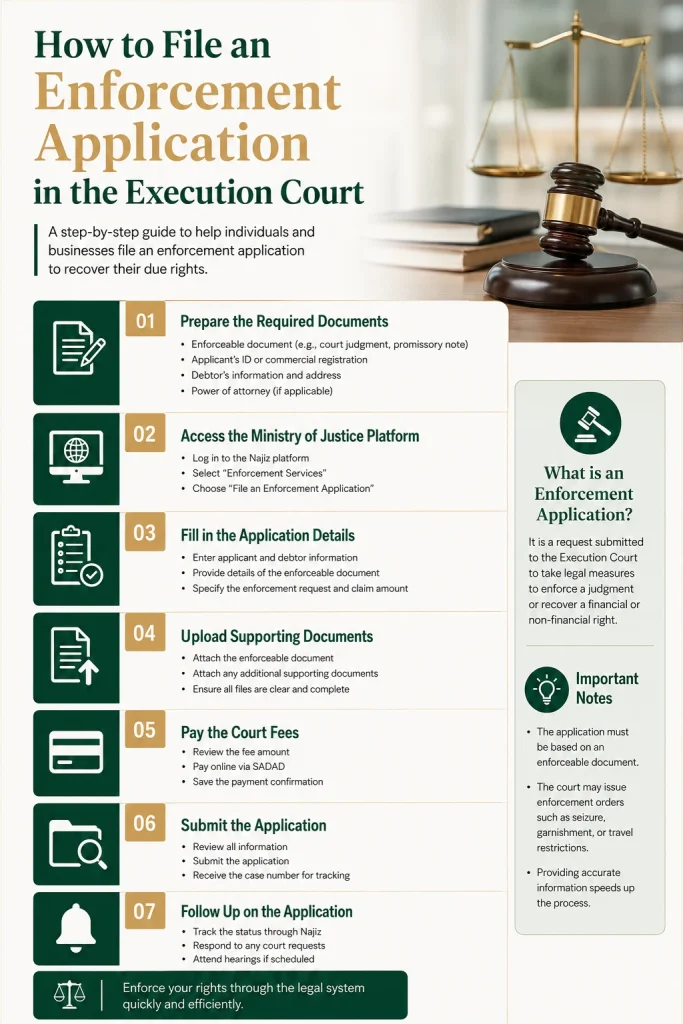
How to File an Enforcement Application in the Execution Court
Here is how to file enforcement application Saudi execution court matters work in practice. The execution court (also called the enforcement court) has exclusive power over enforcement in the Kingdom and operates in Riyadh, Jeddah, and other cities, mostly through the Ministry of Justice digital platform.
The main steps are:
- Pre-filing checks confirm your judgment is final, check that reciprocity exists, and make sure there is no conflicting Saudi case.
- Prepare the file gather a certified copy of the judgment, a certificate of finality, proof of service, the arbitration agreement (for awards), apostille or legalization, certified Arabic translations, and a power of attorney for your Saudi lawyer.
- Submit the application file electronically with the execution court.
- Court review the judge checks the Article 9 conditions, not the merits of the case.
- Enforcement order if all conditions are met, the court issues the enforcement order.
Note that the debtor can raise an “enforcement dispute” to challenge the conditions, which may add time. Our collection services in Saudi Arabia team manages this stage from start to finish.
Asset Seizure and Recovery
Once the court recognizes your judgment, the real recovery begins. In a Saudi execution court asset seizure foreign creditor scenario, the execution judge can order powerful measures: disclosing the debtor’s assets, freezing and seizing bank accounts, attaching property, and even imposing travel bans on the debtor. Under the 2026 law, government registries must cooperate quickly, which speeds up asset tracing. A commercial lawyer in Saudi Arabia can guide you through each enforcement tool to maximize recovery. For money claims in particular, see our focused guide on how to enforce a foreign debt judgment in Saudi Arabia.
How AlKhorayef Law Firm Can Help
At AlKhorayef Law Firm, we manage the full enforcement journey for you from the reciprocity analysis and document legalization to filing at the execution court and seizing assets. We prepare your file to meet every Article 9 condition, handle Arabic translation, and represent you through any enforcement dispute. You focus on recovery; we handle the legal detail. Explore our full range of legal services in Saudi Arabia or contact us to start enforcing your foreign judgment in the Kingdom today.

Frequently Asked Questions (FAQs)
1. Can I Enforce a UK Court Judgment in Saudi Arabia?
It is possible but difficult. There is no treaty between the UK and Saudi Arabia for mutual enforcement of court judgments, so you must prove reciprocity case by case. A UK-seated arbitral award is usually much easier to enforce under the New York Convention.
2. What Is the Reciprocity Requirement for Foreign Judgments in Saudi Arabia?
Reciprocity means the country where your judgment was issued would also enforce a Saudi judgment. You must show proof, such as a treaty, past enforcement of Saudi rulings, or an expert legal opinion from that country.
3. How Do I File an Enforcement Application in the Saudi Execution Court?
You file electronically with the execution court, attaching a certified copy of the final judgment, proof of finality and service, certified Arabic translations, legalized documents, and a power of attorney. The judge then checks the legal conditions before issuing an enforcement order.
4. Which Foreign Judgments Are Not Enforceable in Saudi Arabia?
Judgments that break Sharia or public order are not enforced. This includes interest (riba), rulings over Saudi real estate, criminal and administrative judgments without a treaty, and any judgment that conflicts with an earlier Saudi decision.
5. How Are Foreign Arbitral Awards Recognized Under the New York Convention?
Saudi Arabia is a member of the 1958 New York Convention, and courts accept Convention membership as proof of reciprocity for arbitral awards. You submit the award, the arbitration agreement, and certified Arabic translations, and the judge checks the conditions without reviewing the merits.
6. Do I Need an Apostille for My Foreign Judgment Documents?
If your documents come from a Hague Apostille Convention member state, an apostille is usually enough. Otherwise, you need full consular legalization. In all cases, documents must be translated into Arabic by a licensed translator.
7. How Does the GCC Convention Help Enforce Judgments in Saudi Arabia?
The GCC Convention lets a judgment from one Gulf state be enforced in the others if it is enforceable in the country of origin. It also removes much of the reciprocity burden, making enforcement of Gulf judgments faster and simpler.
8. What Can the Execution Court Do to Seize a Debtor’s Assets?
After recognizing your judgment, the execution judge can order asset disclosure, freeze and seize bank accounts, attach property, and impose travel bans on the debtor. The 2026 law also requires government registries to cooperate quickly.
This article is for general information only and does not replace legal advice. For guidance on your specific situation, please contact AlKhorayef Law Firm.