
If a company or person in the Kingdom owes you money, and you already hold a judgment from a court abroad, you are probably asking one simple question: can I actually collect? The honest answer is yes, it is possible but only if you follow the right path. Saudi Arabia does not automatically rubber-stamp a foreign ruling. It applies its own conditions, and one wrong step early on can cost you the whole claim. Our team handles cross-border recovery for international clients, and in this guide we explain in plain English how to enforce a foreign judgment in Saudi Arabia, what the reciprocity rule means, and what changed under the new 2026 law.
First, the Costly Mistake to Avoid
Before anything else, here is the warning that saves creditors the most money. Saudi courts will not enforce the interest portion of a foreign judgment. Interest is treated as riba, which is prohibited under Islamic law. So an interest award not enforceable Saudi Arabia outcome is normal, not a surprise. If your foreign judgment mixes the principal debt with interest and penalties, you must separate the principal clearly before you file. Creditors who ignore this often see their whole application stumble. We always review the judgment first and isolate the recoverable principal.
How Recovery Works: The Two Routes
There are two main ways to pursue how to recover debt from Saudi Arabia.
The first is Saudi Arabia debt recovery without court a structured demand and negotiation process before any litigation. Many debts are settled this way once a debtor understands a credible enforcement threat is coming. This is faster and cheaper, and it is where our collection services and B2B debt collection work begins. Our wider debt collection legal guide explains this stage in detail.
The second route is formal enforcement through the Execution Court, which is what you need when you already hold a foreign court judgment recognized Saudi Arabia must process. That is the focus of the rest of this guide.
The Reciprocity Rule, Explained Simply
The heart of the system is reciprocity. Saudi Arabia reciprocity judgment enforcement means the court must be satisfied that the country where your judgment was issued would, in turn, enforce a Saudi judgment. If there is no mutual arrangement, the Execution Court can refuse your application.
So, does Saudi Arabia enforce UK or US court judgments? This is where many creditors are caught out. Saudi Arabia has no bilateral enforcement treaty with the UK or the US. Enforcing a judgment from these countries is therefore harder. You usually must provide expert evidence showing a Saudi judgment would be honoured there. Historically, enforcing non-treaty judgments has been difficult and slow.
By contrast, the picture is far better within the region. Under the Riyadh Arab Agreement judicial cooperation treaty of 1983 (covering Arab League states) and the 1996 GCC Convention, judgments move more smoothly. GCC judgment enforcement Saudi Arabia for creditors in the UAE, Bahrain, Kuwait, Oman, and Qatar follows a simplified path: a judgment that is final and enforceable in the origin state is generally enforceable in the Kingdom.
There is also an important shortcut. A foreign arbitration award Saudi Arabia case follows a separate pathway under the New York Convention, which has narrower refusal grounds and does not depend on the same reciprocity test. This is one reason many international contracts choose arbitration over court litigation from the start.
What Changed in April 2026: Saudi Arabia’s New Execution Law Explained
Now to the big update. Saudi Arabia new execution law 2026 is a real and major reform. By Royal Decree No. M/237, the Council of Ministers approved a new Enforcement Law in April 2026 that replaces the entire 2012 framework. The law was published in the Official Gazette and comes into force 180 days after publication, later in 2026, with implementing regulations to follow. Because the timing matters for any active case, our full corporate guide to the new 2026 Enforcement Law (Royal Decree M/237) is worth reading alongside this article.
The key change for creditors sits in the new Saudi Arabia Article 9 enforcement reciprocity rule. Under Article 9, the Execution Court will not declare a foreign judgment enforceable unless reciprocity exists and several conditions are met. In plain English, these conditions are:
- The dispute does not fall under the exclusive jurisdiction of the Saudi courts.
- There is no similar case already filed and pending in the Kingdom that was started before the foreign case.
- All parties were properly notified and had a fair chance to defend themselves.
- The foreign judgment is final and binding.
- The judgment does not breach Saudi public order (which is why interest is stripped out).
The “no earlier pending Saudi case” condition is new compared to the old 2012 law, so creditors should check this point carefully before filing.
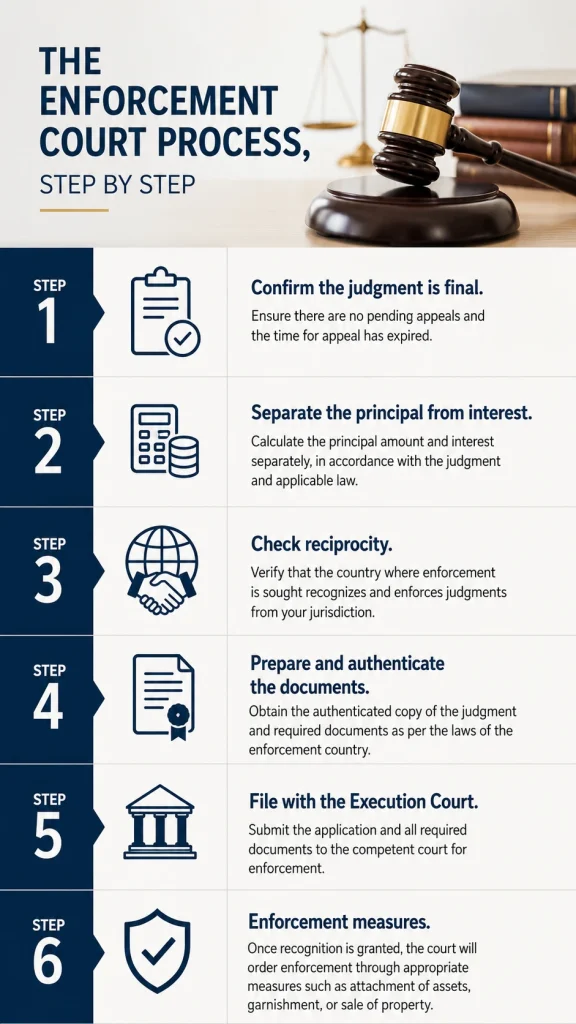
The Enforcement Court Process, Step by Step
Here are the Saudi Arabia enforcement court process steps in order, so you know what to expect when you ask can I collect a debt judgment in Saudi Arabia:
Step 1 Confirm the judgment is final. Only a final, binding judgment qualifies. A ruling still under appeal will be rejected.
Step 2 Separate the principal from interest. Remove interest and penalty components, since these are not enforceable.
Step 3 Check reciprocity. Identify whether a treaty applies (Riyadh or GCC) or whether you must prove reciprocity by expert evidence.
Step 4 Prepare and authenticate the documents. Translate and legalise everything (see the checklist below). Powers of attorney are confirmed through our notary services.
Step 5 File with the Execution Court. Submit the enforcement petition. The Execution Court has exclusive authority over enforcement in the Kingdom.
Step 6 Enforcement measures. Once granted, the court can apply real pressure. A Saudi enforcement court travel ban debtor order is one of the strongest tools, alongside freezing accounts and seizing assets. Our enforcement services and litigation services manage this stage end to end.
Document Checklist
Creditors often search for the Saudi Arabia judgment enforcement documents required. The core package is:
- A certified copy of the final foreign judgment.
- A sworn Arabic translation of the judgment.
- Authentication and legalisation (apostille or consular chain, plus Saudi Ministry of Foreign Affairs attestation).
- Evidence of reciprocity (a treaty reference or an expert affidavit).
- A notarised power of attorney appointing your Saudi counsel.
- Corporate identification documents, if the creditor is a company.
- A written enforcement petition.
Missing or poorly legalised papers are the most common reason applications stall, so this stage deserves care.
How We Help International Creditors
Cross-border recovery rewards preparation. We assess whether your judgment qualifies, separate the recoverable principal, build the reciprocity evidence, prepare a clean document bundle, and drive the case through the Execution Court. As a commercial lawyer in Saudi Arabia and trusted legal advisors, we also help foreign businesses avoid the common legal mistakes foreign investors make in Saudi Arabia. Where recovery touches a deceased debtor’s assets, we coordinate with our estate liquidation services so nothing is lost.
If you are owed money by a Saudi-based debtor, do not wait for the position to weaken. Contact us and our cross-border recovery team will tell you, clearly, whether your judgment can be enforced and what it will take.

Frequently Asked Questions
1. Can A Foreign Company Enforce A Debt Judgment In Saudi Arabia?
Yes, a foreign company can enforce a debt judgment, but it must go through the Execution Court and satisfy the conditions in the law, including reciprocity, finality, and proper service. The interest portion of the judgment will not be enforced. Strong document preparation is essential, and most foreign creditors appoint Saudi counsel to manage the process.
2. What Is The Reciprocity Requirement For Enforcing Judgments In Saudi Arabia?
Reciprocity means the Execution Court must be satisfied that the foreign country would enforce a Saudi judgment in return. Where a treaty applies, such as the Riyadh Convention or the GCC Convention, reciprocity is treated as established. Where no treaty exists, you must prove reciprocity with expert evidence from the originating country.
3. Does Saudi Arabia Enforce UK Or US Court Judgments?
There is no bilateral enforcement treaty between Saudi Arabia and either the UK or the US, so enforcement is harder and slower. You generally must provide expert legal evidence that the foreign court would enforce a Saudi judgment. For this reason, arbitration awards under the New York Convention are often an easier route for parties from these countries.
4. What Documents Do I Need To Enforce A Foreign Judgment In Saudi Arabia?
You need a certified copy of the final judgment, a sworn Arabic translation, full authentication and legalisation (apostille or consular chain plus Saudi MOFA attestation), evidence of reciprocity, a notarised power of attorney for your Saudi lawyer, corporate identity documents if you are a company, and a written enforcement petition.
5. Can Saudi Courts Enforce Interest Awarded By A Foreign Court?
No. Interest is treated as riba and is prohibited under Islamic law, so Saudi courts strip out the interest component. You can still recover the principal debt. Separate the principal from any interest and penalties before you file to avoid delay.
6. How Long Does Debt Enforcement Take In Saudi Arabia?
It depends heavily on the route. A clean, uncontested case under a treaty pathway can move in a few months. A non-treaty judgment that requires proving reciprocity, or one that is contested, can take much longer and sometimes years. Good preparation is the single biggest factor in speed.
7. What Is The Saudi Execution Court And How Does It Work?
The Execution Court (also called the Enforcement Court) has exclusive authority over enforcement in the Kingdom. It reviews the enforcement petition, confirms the legal conditions are met, and then issues enforcement measures which can include freezing bank accounts, seizing assets, and imposing a travel ban on the debtor until the debt is paid.