
Delayed payments and unpaid commercial invoices are among the most serious financial challenges businesses face in today’s competitive market environment. Whether involving contractors, suppliers, distributors, manufacturers, financial institutions, or multinational corporations, unresolved receivables can place significant pressure on cash flow, operations, and long-term business stability.
As Saudi Arabia continues expanding its commercial and investment landscape under Vision 2030, the volume of corporate transactions across industries has increased substantially. At the same time, businesses operating in the Kingdom are increasingly exposed to:
- overdue payments,
- breached contractual obligations,
- disputed invoices,
- and complex cross-border recovery challenges.
Recovering commercial debts in Saudi Arabia requires more than routine follow-up communication or informal payment reminders. Effective debt recovery often depends on:
- legal strategy,
- enforcement leverage,
- procedural compliance,
- and strong negotiation management.
At Alkhorayef Law Firm, we provide professional collection services in Saudi Arabia for local and international businesses seeking efficient, legally compliant, and commercially strategic debt recovery solutions.
Our legal team advises clients on:
- unpaid invoice recovery,
- corporate debt collection,
- enforcement proceedings,
- commercial litigation,
- asset tracing,
- and cross-border debt recovery matters throughout Saudi Arabia.
Understanding Commercial Debt Collection in Saudi Arabia
Commercial debt collection in Saudi Arabia involves a structured legal and strategic process designed to help businesses recover unpaid financial obligations arising from commercial transactions, contractual relationships, and corporate dealings. As the Kingdom continues strengthening its regulatory and judicial infrastructure, debt recovery procedures have become increasingly sophisticated, particularly for corporate and cross-border disputes.
Unlike consumer collections, which typically involve individuals and lower-value liabilities, commercial debt collection focuses on business-to-business recovery matters involving:
- unpaid invoices,
- contractor disputes,
- financing obligations,
- commercial agreements,
- and high-value corporate receivables.
B2B debt recovery is often significantly more complex because commercial disputes may involve multiple contractual layers, disputed obligations, delayed project certifications, international suppliers, or financially distressed corporate entities. In many situations, recovery efforts must balance legal enforcement with commercial negotiation strategies in order to protect both financial interests and ongoing business relationships.
Under Saudi debt collection law, creditors may pursue recovery through several channels depending on the nature of the claim and supporting documentation. Some matters can proceed through negotiated settlement discussions, while others require judicial enforcement proceedings or formal commercial litigation before the Saudi courts.
The debt recovery process in Saudi Arabia generally involves:
- legal review of contractual documentation,
- formal demand notices,
- settlement negotiations,
- enforcement preparation,
- and judicial recovery proceedings where necessary.
Saudi Arabia’s Enforcement Courts now play a central role in commercial collections and creditor protection. The courts possess significant authority to support debt recovery through measures such as:
- bank account attachment,
- asset freezing,
- financial disclosure orders,
- and enforcement actions against non-compliant debtors.
However, commercial debt recovery is rarely straightforward without proper legal guidance. Businesses attempting to recover debts without professional legal support often face challenges involving:
- incomplete documentation,
- procedural errors,
- delayed enforcement action,
- disputed contractual terms,
- and ineffective negotiation strategies.
In higher-value disputes, delays in legal escalation may also allow debtors additional time to restructure assets, complicate financial tracing efforts, or weaken the creditor’s overall recovery position.
For this reason, many businesses operating in Saudi Arabia rely on professional legal recovery support to improve recovery efficiency, preserve enforcement rights, and strengthen their overall commercial leverage.
At Alkhorayef Law Firm, we advise local and international businesses on commercially strategic recovery solutions tailored to Saudi Arabia’s evolving enforcement and litigation framework.
What Types of Debts Can Be Recovered?
Commercial debt recovery in Saudi Arabia applies to a broad range of financial and contractual obligations across multiple industries. The legal recovery strategy often depends on the nature of the debt, the available documentation, and whether the claim is disputed.
At Alkhorayef Law Firm, we support businesses, financial institutions, contractors, suppliers, and international corporations in recovering various forms of commercial receivables and financial claims throughout Saudi Arabia.
Unpaid Commercial Invoices
Unpaid invoices remain one of the most common forms of commercial debt faced by businesses operating in Saudi Arabia. These disputes frequently arise from:
- supply agreements,
- procurement contracts,
- consulting services,
- distribution relationships,
- and long-term commercial arrangements.
Delayed invoice payments can significantly affect cash flow management, operational planning, and supplier relationships, particularly for companies managing large-scale projects or extended payment cycles.
In many cases, businesses continue attempting informal collection efforts for extended periods before seeking legal support. However, delayed escalation often weakens recovery leverage and increases enforcement risks.
Professional legal collection services help businesses pursue unpaid receivables through structured negotiation strategies, formal legal notices, and judicial recovery procedures where necessary.
Construction and Contractor Payment Disputes
Construction and infrastructure disputes represent one of the most significant categories of commercial debt recovery matters in Saudi Arabia’s rapidly expanding economy.
Contractors, subcontractors, engineering firms, suppliers, and project developers frequently encounter payment disputes involving:
- delayed project payments,
- retention amounts,
- disputed milestones,
- variation claims,
- and unpaid contractual obligations.
Because construction projects often involve multiple stakeholders and layered contractual structures, payment disputes can quickly become legally and financially complex.
In many situations, recovery efforts require detailed contractual analysis, technical documentation review, and strategic negotiation before formal legal proceedings begin.
Construction-related debt recovery may also intersect with:
- enforcement proceedings,
- performance disputes,
- and commercial litigation matters involving high-value contractual claims.
Cheques and Promissory Notes
Cheques and promissory notes remain important financial instruments within Saudi Arabia’s commercial environment and continue to play a significant role in corporate transactions and payment security.
When properly executed, these instruments may provide creditors with stronger legal leverage and more direct enforcement opportunities through the Saudi Enforcement Courts.
Businesses frequently rely on promissory notes and post-dated cheques to secure:
- supplier payments,
- financing arrangements,
- contractor obligations,
- and commercial guarantees.
Where default occurs, creditors may pursue judicial enforcement measures to recover outstanding amounts through court-supervised execution procedures.
Because enforcement involving negotiable instruments is highly procedural, businesses often require specialized legal guidance to protect enforcement rights and avoid procedural deficiencies during recovery proceedings.
For judicial execution matters involving unpaid financial instruments, integrated Enforcement Services in Saudi Arabia may become essential to support efficient recovery.
Corporate Loan and Financing Defaults
Commercial recovery matters may also involve corporate financing disputes arising from:
- business loans,
- shareholder obligations,
- financing facilities,
- repayment guarantees,
- and structured commercial lending arrangements.
These disputes often involve substantial financial exposure and may require both negotiation and formal enforcement strategies depending on the debtor’s financial position and available recovery options.
In complex financing disputes, creditors frequently require coordinated legal support involving:
- contractual analysis,
- financial review,
- enforcement planning,
- and litigation management.
Professional recovery strategies become particularly important where debtors attempt to delay repayment, dispute contractual obligations, or restructure financial holdings.
Cross-Border and International Commercial Debts
As Saudi Arabia continues attracting international investment and commercial activity, cross-border debt recovery has become increasingly important for:
- foreign companies,
- multinational corporations,
- international suppliers,
- overseas contractors,
- and GCC-based businesses.
International commercial recovery matters often involve additional legal and operational complexities related to:
- jurisdictional issues,
- foreign documentation,
- multilingual contracts,
- overseas assets,
- and international enforcement coordination.
Foreign businesses attempting to recover debts in Saudi Arabia frequently encounter challenges involving:
- local procedural requirements,
- enforcement regulations,
- debtor tracing,
- and judicial compliance standards.
At Alkhorayef Law Firm, we support domestic and international creditors with commercially strategic recovery solutions tailored to Saudi Arabia’s legal and enforcement framework.
As the official Saudi Arabia representative of the TCM Group, our firm also assists clients with coordinated cross-border recovery matters across more than 120 countries.

Our Professional Collection Process
Successful debt recovery in Saudi Arabia requires far more than repetitive payment reminders or generic collection efforts. In many commercial disputes, businesses lose valuable recovery opportunities because enforcement action is delayed, documentation is weak, or negotiations are handled without proper legal strategy.
At Alkhorayef Law Firm, our approach to commercial debt collection is structured around legal precision, strategic negotiation, and enforcement-focused recovery planning. Every matter is assessed individually to determine the most effective and commercially practical route toward recovery.
Our collection process is designed not only to recover outstanding amounts, but also to protect our clients’ legal position, preserve commercial leverage, and minimize unnecessary procedural delays.
Legal Review and Case Assessment
Every recovery matter begins with a detailed legal and commercial assessment of the debt. This stage is critical because the quality of documentation often determines the strength of the creditor’s enforcement position.
Our legal team carefully reviews:
- commercial agreements,
- invoices,
- payment records,
- correspondence,
- guarantees,
- promissory notes,
- and any supporting financial documentation connected to the claim.
During this process, we evaluate:
- whether the debt is disputed,
- whether direct enforcement options are available,
- potential recovery risks,
- and the most strategic legal path forward.
Early legal assessment frequently helps businesses avoid procedural mistakes that could weaken future enforcement proceedings.
Legal Demand Notices and Strategic Recovery Communication
Once the claim is reviewed, formal legal communication is typically initiated with the debtor. Professionally drafted legal demand notices often create immediate pressure by demonstrating that the matter is being handled through structured legal channels rather than informal collection activity.
In Saudi Arabia, many debtors respond differently once legal representation becomes involved. Formal notices establish:
- the legal basis of the claim,
- the creditor’s intent to pursue recovery,
- and the potential legal consequences of continued non-payment.
At this stage, our objective is not simply aggressive collection activity. Instead, we focus on creating commercially strategic leverage that encourages faster resolution while protecting our client’s legal rights.
In many cases, professionally managed negotiations lead to settlement before formal court proceedings become necessary.
Settlement Negotiations and Structured Payment Solutions
Not all commercial recovery matters require immediate judicial escalation. In some situations, negotiated settlement arrangements may provide the most efficient and commercially beneficial outcome.
Our legal team assists clients in evaluating:
- installment proposals,
- restructuring arrangements,
- partial settlements,
- payment guarantees,
- and revised commercial terms where appropriate.
However, settlement negotiations must be approached carefully. Informal promises or poorly drafted payment arrangements often create additional complications later if the debtor defaults again.
For this reason, all negotiated settlements should be legally structured in a manner that preserves enforcement rights and reduces future recovery risks.
Asset Tracing and Financial Investigation
In higher-value commercial disputes, identifying recoverable assets becomes a critical component of successful debt recovery. Debtors may attempt to delay enforcement by restructuring holdings, transferring funds, or obscuring asset ownership.
Saudi Arabia’s evolving enforcement framework has strengthened judicial authority regarding asset disclosure and financial investigation procedures. Courts now possess broader powers to support creditors seeking recovery against non-compliant debtors.
Where necessary, our legal team works closely with clients to support:
- asset tracing efforts,
- financial investigations,
- ownership analysis,
- and recovery strategy planning.
This process becomes especially important in disputes involving:
- corporate entities,
- complex ownership structures,
- cross-border transactions,
- or substantial outstanding liabilities.
Businesses dealing with financially sensitive disputes may also require coordinated Asset Management Services in Saudi Arabia to support long-term recovery and asset protection strategies.
Judicial Enforcement Proceedings in Saudi Arabia
Where voluntary payment efforts fail, formal enforcement proceedings may become necessary to secure recovery through the Saudi judicial system.
Saudi Enforcement Courts possess significant authority to compel compliance with enforceable financial obligations. Depending on the nature of the claim and supporting documentation, enforcement measures may include:
- bank account attachment,
- asset freezing,
- financial disclosure orders,
- restrictions on commercial activity,
- and judicial execution procedures.
Enforcement actions involving:
- promissory notes,
- cheques,
- final judgments,
- and authenticated obligations
often provide stronger legal leverage under Saudi law.
Because enforcement procedures are highly technical and time-sensitive, strategic legal management is essential throughout the process.
Clients pursuing formal execution proceedings may require integrated Enforcement Services in Saudi Arabia to navigate judicial recovery procedures effectively.
Commercial Litigation for Disputed Debts
Where liability is contested or contractual disputes arise, debt recovery may proceed through the Commercial Courts rather than direct enforcement channels.
Commercial litigation matters often involve:
- disputed contractual obligations,
- project-related payment conflicts,
- performance allegations,
- counterclaims,
- and shareholder or partnership disputes.
These matters require a broader legal strategy beyond standard collection activity. Successful litigation depends on:
- contractual analysis,
- evidentiary preparation,
- procedural management,
- and commercially strategic representation before the courts.
At Alkhorayef Law Firm, we advise clients on complex commercial recovery disputes involving both domestic and international business relationships.
For disputed matters requiring judicial representation, our integrated Commercial Litigation Services in Saudi Arabia provide businesses with strategic legal support throughout the litigation process.
Why Businesses Choose Professional Collection Services in Saudi Arabia

Unpaid receivables can create serious operational and financial pressure for businesses of all sizes. In Saudi Arabia’s increasingly competitive commercial environment, delayed payments not only affect immediate cash flow, but may also disrupt supplier relationships, project execution, investment planning, and long-term business stability.
Many companies initially attempt to recover debts internally through repeated follow-ups, informal reminders, or extended payment discussions. However, without structured legal strategy and enforcement leverage, recovery efforts often become prolonged, inefficient, and commercially damaging.
Professional collection services provide businesses with a more strategic and legally structured approach to debt recovery. Rather than relying solely on pressure-based collection tactics, experienced legal recovery teams focus on:
- preserving creditor rights,
- strengthening negotiation leverage,
- protecting commercial interests,
- and maximizing recovery opportunities within Saudi Arabia’s legal framework.
One of the primary advantages of professional debt collection is the ability to escalate matters strategically before disputes become significantly more difficult to resolve. Early legal intervention often increases the likelihood of successful recovery by demonstrating that the creditor is prepared to pursue formal legal and enforcement action if necessary.
Professional recovery support also helps businesses avoid procedural mistakes that may weaken future claims. Commercial disputes frequently involve:
- incomplete documentation,
- disputed contractual terms,
- delayed legal escalation,
- or ineffective settlement arrangements.
Without proper legal oversight, businesses may unintentionally compromise their enforcement position or allow debtors additional time to restructure assets and complicate recovery efforts.
In many situations, professionally managed negotiations also help preserve valuable business relationships while still protecting the creditor’s financial interests. Structured legal communication often creates stronger incentives for repayment than informal collection efforts alone.
For companies managing high-value receivables, complex contractual disputes, or international recovery matters, legal collection services provide additional strategic advantages through:
- enforcement preparation,
- asset tracing support,
- judicial recovery planning,
- and litigation management where necessary.
At Alkhorayef Law Firm, we assist businesses across Saudi Arabia with commercially focused debt recovery strategies designed to balance efficient recovery with long-term legal and financial protection.
Debt Collection for Foreign Companies in Saudi Arabia
Saudi Arabia’s growing position as a regional commercial and investment hub has led to a significant increase in cross-border business transactions involving:
- international suppliers,
- multinational corporations,
- foreign contractors,
- logistics providers,
- and overseas service companies.
While these opportunities continue expanding under Vision 2030, foreign businesses operating in Saudi Arabia also face increasing exposure to unpaid commercial debts, delayed contractual payments, and cross-border recovery disputes.
Recovering debts in Saudi Arabia as a foreign company often presents unique legal and operational challenges. International creditors frequently encounter difficulties involving:
- local procedural requirements,
- Arabic-language documentation,
- enforcement regulations,
- jurisdictional issues,
- and unfamiliar judicial processes.
In many situations, foreign businesses may lack direct local representation or sufficient understanding of Saudi Arabia’s enforcement system, making recovery efforts slower and significantly more complicated.
Commercial recovery matters involving international transactions often require careful coordination between:
- contractual analysis,
- local enforcement procedures,
- cross-border documentation,
- and strategic negotiation management.
This becomes particularly important in disputes involving:
- construction projects,
- international supply agreements,
- GCC commercial relationships,
- multinational procurement contracts,
- and overseas financing arrangements.
Saudi Arabia’s evolving enforcement framework has strengthened creditor protection and expanded judicial recovery mechanisms in recent years. However, successful recovery still depends heavily on:
- proper legal documentation,
- strategic enforcement timing,
- and effective local representation.
Foreign creditors pursuing recovery in Saudi Arabia may require support involving:
- debtor tracing,
- legal notices,
- settlement negotiations,
- enforcement proceedings,
- and commercial litigation before the Saudi courts.
At Alkhorayef Law Firm, we advise international businesses and overseas creditors on commercially strategic debt recovery solutions tailored to Saudi Arabia’s legal and enforcement environment.
As the official Saudi Arabia representative of the TCM Group, our firm supports coordinated international recovery matters across more than 120 countries, helping foreign businesses navigate complex cross-border commercial disputes more efficiently.
Saudi Enforcement Law and Creditor Rights
Saudi Arabia’s enforcement framework has undergone significant modernization in recent years, strengthening the legal position of creditors and improving judicial recovery mechanisms for commercial disputes.
The Saudi Enforcement Courts play a central role in the debt recovery process by supervising judicial execution procedures and compelling compliance with enforceable financial obligations.
Depending on the nature of the claim and supporting legal documentation, creditors may pursue enforcement measures involving:
- bank account attachment,
- asset freezing,
- financial disclosure orders,
- travel restrictions,
- suspension of certain commercial activities,
- and court-supervised execution procedures.
The strength of the creditor’s position often depends on the quality of the underlying documentation and whether the claim qualifies as an enforceable instrument under Saudi law.
Commercial recovery matters involving:
- promissory notes,
- cheques,
- final judgments,
- notarized obligations,
- and authenticated financial agreements
may provide stronger and faster enforcement opportunities through the Enforcement Courts.
Saudi Arabia’s updated enforcement framework has also expanded judicial authority regarding asset tracing and financial disclosure. Courts now possess broader powers to investigate debtor assets and compel cooperation from relevant financial and regulatory entities during recovery proceedings.
However, enforcement procedures remain highly technical and procedural. Creditors attempting to pursue judicial recovery without proper legal guidance may encounter:
- procedural delays,
- filing deficiencies,
- enforcement objections,
- and weakened recovery leverage.
For this reason, many businesses rely on professional legal support to manage enforcement strategy, preserve procedural compliance, and maximize recovery efficiency.
Businesses requiring formal judicial execution support may benefit from integrated Enforcement Services in Saudi Arabia designed to support commercially strategic recovery proceedings across Saudi Arabia.
Common Challenges in Commercial Debt Recovery
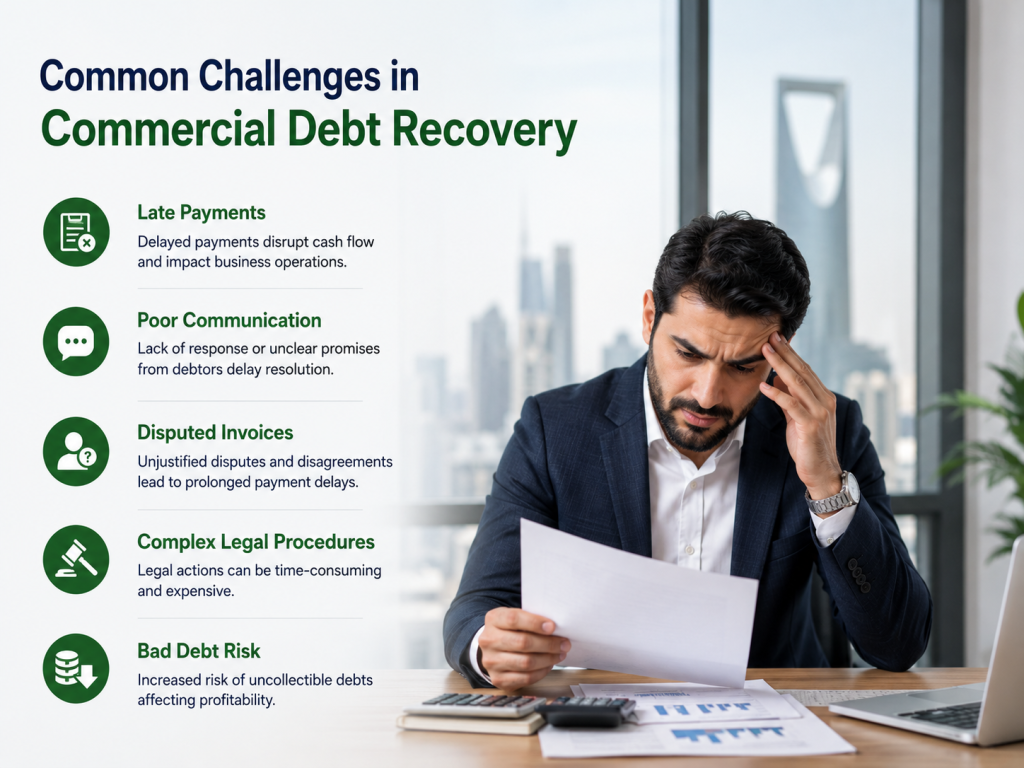
Commercial debt recovery in Saudi Arabia is often more complex than businesses initially expect. While many creditors assume that unpaid invoices or contractual obligations can be resolved quickly through basic collection efforts, recovery proceedings frequently become complicated by procedural, financial, and strategic challenges.
In many situations, delayed legal action significantly weakens the creditor’s position and reduces the likelihood of efficient recovery.
One of the most common challenges involves debtors intentionally delaying negotiations while attempting to manage financial exposure internally. Businesses facing financial pressure may prolong discussions, dispute documentation, or repeatedly promise future payment without taking meaningful action toward settlement.
In higher-value disputes, delays can also create opportunities for debtors to:
- restructure financial holdings,
- transfer assets,
- reduce liquidity,
- or complicate enforcement efforts before judicial proceedings begin.
Another major challenge arises from incomplete or poorly structured documentation. Commercial disputes involving:
- unsigned agreements,
- unclear payment terms,
- inconsistent invoices,
- or weak contractual protections
often become significantly more difficult to enforce through the courts.
This issue is especially common in construction, subcontracting, and long-term supplier relationships where commercial arrangements may evolve over time without proper legal documentation updates.
Cross-border recovery matters create additional complications for foreign businesses attempting to recover debts within Saudi Arabia’s legal framework. International creditors may encounter difficulties involving:
- jurisdictional disputes,
- language barriers,
- foreign documentation requirements,
- enforcement recognition procedures,
- and unfamiliar judicial processes.
Without experienced local legal support, international recovery efforts can quickly become slow, costly, and procedurally difficult.
Commercial debt recovery also becomes more challenging when disputes escalate beyond straightforward non-payment matters into broader contractual disagreements. Debtors may attempt to raise:
- performance-related defenses,
- project delay allegations,
- counterclaims,
- or contractual interpretation disputes
in order to delay or weaken recovery proceedings.
In these situations, creditors often require a broader legal strategy involving:
- commercial litigation,
- evidentiary preparation,
- enforcement planning,
- and negotiation management.
Another increasingly important challenge involves tracing recoverable assets. In some commercial disputes, creditors may suspect that debtors are attempting to conceal financial holdings or reduce visible asset exposure before enforcement action begins.
Saudi Arabia’s evolving enforcement framework has strengthened judicial powers regarding asset tracing and financial disclosure. However, successful recovery still depends heavily on:
- strategic timing,
- proper documentation,
- and effective legal management throughout the recovery process.
At Alkhorayef Law Firm, we assist businesses with commercially focused recovery strategies designed to address both the legal and practical challenges associated with complex debt recovery matters in Saudi Arabia.
Why Choose Al Khorayef Law Firm for Collection Services in Saudi Arabia
Commercial debt recovery requires far more than standard collection activity. Businesses pursuing unpaid receivables often need legal advisors who understand not only Saudi Arabia’s judicial framework, but also the financial, operational, and commercial realities surrounding corporate disputes.
At Alkhorayef Law Firm, we provide commercially strategic collection and debt recovery services tailored to the needs of both domestic and international businesses operating across Saudi Arabia.
Our legal team advises clients on:
- unpaid commercial invoices,
- contractor payment disputes,
- enforcement proceedings,
- cross-border recovery,
- financial claims,
- and complex commercial litigation matters.
Unlike traditional collection agencies, our approach is built around legal recovery strategy, enforcement leverage, and long-term commercial protection. We focus not only on recovering outstanding amounts, but also on preserving our clients’ legal position and minimizing future recovery risks.
From our headquarters in Riyadh, we support businesses across multiple industries including:
- construction,
- manufacturing,
- logistics,
- financial services,
- healthcare,
- retail,
- and international trade.
Our integrated legal capabilities allow us to support clients throughout every stage of the recovery process, including:
- legal demand procedures,
- settlement negotiations,
- enforcement actions,
- asset tracing,
- and commercial litigation where necessary.
Clients requiring broader judicial recovery support may also benefit from our:
- Enforcement Services in Saudi Arabia
- Commercial Litigation Services in Saudi Arabia
- Asset Management Services in Saudi Arabia
As the official Saudi Arabia representative of the TCM Group, our firm also supports coordinated international debt recovery matters across more than 120 countries.
This international capability provides significant value for:
- foreign companies,
- multinational corporations,
- international suppliers,
- and overseas creditors
seeking commercially effective recovery solutions within Saudi Arabia’s legal framework.

Frequently Asked Questions About Collection Services in Saudi Arabia
1. How long does commercial debt recovery usually take in Saudi Arabia?
The timeline for debt recovery in Saudi Arabia depends on several factors, including the nature of the claim, the quality of documentation, whether the debt is disputed, and the debtor’s willingness to cooperate. Some commercial matters may be resolved through negotiation within a relatively short period, while disputed or enforcement-related cases may require formal judicial proceedings before the Saudi courts.
2. Can foreign companies legally recover debts from Saudi businesses?
Yes. Foreign companies, international suppliers, and overseas contractors can pursue debt recovery through Saudi Arabia’s legal and enforcement system. However, cross-border recovery often requires local legal representation, Arabic documentation management, and strategic coordination with Saudi judicial procedures to improve recovery efficiency.
3. What documents are important for commercial debt collection?
Strong documentation significantly improves the creditor’s legal and enforcement position. Commercial recovery matters commonly require contracts, invoices, payment records, purchase orders, correspondence, promissory notes, cheques, and other supporting commercial documents connected to the transaction or dispute.
4. What happens if the debtor refuses to pay after legal notice?
If settlement discussions fail or the debtor continues refusing payment, creditors may pursue formal legal recovery through Saudi Arabia’s Enforcement Courts or Commercial Courts depending on the nature of the dispute. Judicial recovery may involve enforcement measures such as asset attachment, financial disclosure orders, and court-supervised execution procedures.
5. Can unpaid invoices be legally enforced in Saudi Arabia?
Yes. Unpaid commercial invoices may be legally recoverable in Saudi Arabia when supported by proper contractual and financial documentation. Depending on the circumstances, creditors may pursue negotiated settlement, enforcement proceedings, or commercial litigation to recover outstanding amounts.
6. Are settlement negotiations possible before filing a court case?
Yes. Many commercial debt recovery matters are resolved through professionally managed settlement negotiations before formal litigation becomes necessary. Strategic legal negotiations often help businesses recover outstanding amounts more efficiently while preserving commercial relationships and reducing procedural costs.
7. Can Saudi courts freeze debtor assets during recovery proceedings?
Saudi Enforcement Courts possess authority to implement certain enforcement measures against non-compliant debtors, including asset attachment and financial disclosure procedures where legally applicable. The availability of these measures depends on the nature of the claim and the supporting legal documentation.
8. Why should businesses use professional collection services instead of internal follow-ups?
Internal recovery efforts are often limited when disputes become legally complex or financially sensitive. Professional collection services provide businesses with structured legal strategy, enforcement preparation, negotiation leverage, and procedural guidance designed to improve recovery outcomes while protecting long-term commercial interests.