Here is the question most people really want answered: how do I make sure my assets go to the right people? Whether you are a Saudi national planning ahead or an expat worried about your family back home, the good news is that the Kingdom has a clear, ordered system. Once you understand the steps, it stops feeling frightening. Our team helps families and foreign residents every week, and in this guide we explain, in plain English, how does inheritance work in Saudi Arabia, how wills fit in, and how an estate is finally settled and distributed.
The Outcome First: How Assets Reach the Right Heirs
When a person passes away in the Kingdom, their estate does not simply disappear into a long court fight. It moves through a fixed order. First, funeral costs and any valid debts are paid. Next, any valid will (called a wasiyya) is honoured within its legal limit. Finally, the remaining estate is divided among the lawful heirs by set shares.
This order is part of Saudi Arabia Sharia inheritance law, which is also shaped by the Saudi Arabia Personal Status Law inheritance 2022 (issued by Royal Decree in March 2022). The 2022 law brought many of these rules into a single written code, which makes the process clearer than it was in the past. If you want to understand how a strong legal plan protects your family the same way it protects a business, our article on how legal advice protects your business in Saudi Arabia makes the same point.
The One-Third Rule, Explained Simply
The single most misunderstood point is the will limit. So here is the Saudi Arabia will one-third rule explained in one line: a person can give away up to one-third of their estate through a wasiyya Islamic will Saudi Arabia document. The other two-thirds must go to the fixed heirs by their legal shares.
There is one more important detail. A bequest under the one-third usually cannot be given to someone who is already a fixed heir, unless all the other heirs agree to it in writing. So the one-third is most useful for people outside the normal heir list for example a charity, a friend, or a relative who would not otherwise inherit.
This naturally leads to a common question: can a will override Sharia inheritance in Saudi Arabia? The honest answer is no, not fully. A will works inside the system, not against it. It is still a powerful tool, but it has a ceiling.
Can Expats Make a Will in Saudi Arabia?
Yes. Can expats make a will in Saudi Arabia is one of the most searched questions, and the answer is that foreign residents can record their wishes. Many expats ask us to draft and notarise a clear will so their intentions are on the record.
But expats should manage their expectations. For Saudi Arabia inheritance rules for non-Muslims, assets located inside the Kingdom are generally handled by the Saudi courts under Islamic principles. A non-Muslim can state in a registered will that they wish their home-country law to apply, and the court may take this into account, but it is not automatic. This is why a foreign will recognised Saudi Arabia outcome is never guaranteed without local legal support. We strongly advise expats not to rely on a will written abroad alone.
So, can a non-Muslim expat write a will in Saudi Arabia? Yes and they should. A properly drafted and notarised will gives the court something clear to work with, reduces family disputes, and speeds up settlement. You can have your documents formally authenticated through our notary services.
What Happens to Expat Assets When They Die in Saudi Arabia
This is the fear-based question, so let us be direct about what happens to expat assets when they die in Saudi Arabia. Bank accounts are usually frozen once the bank is notified of the death. Property, vehicles, end-of-service benefits, and business shares all become part of the estate. Nothing can be released until the heirs are officially identified by the court.
For families with assets in more than one country, cross-border inheritance Saudi Arabia expat matters get more complex. Saudi assets follow Saudi rules, while assets abroad follow the law of that country. Coordinating both sides is exactly the kind of work our lawyers manage so that nothing is lost between two legal systems. Foreign investors should also review the common legal mistakes foreign investors make in Saudi Arabia, as poor estate planning is one of them.
New: What Expats Inheriting Saudi Property Need to Know in 2026
There is a fresh and important angle here. Under the new Real Estate Ownership Law for Non-Saudis (Royal Decree M/14, issued July 2025 and effective in early 2026), foreigners can now own real estate in designated zones of the Kingdom. This is a major change, and it creates brand-new Saudi Arabia real estate inheritance non-Saudi 2026 questions that very few people have planned for yet.
If an expat now owns an apartment in Riyadh or Jeddah, that property becomes a Saudi asset and will pass under Saudi inheritance rules when they die. Heirs may need to register, sell, or transfer the property. Our real estate attorney services and our broader legal services are built to handle exactly this situation. If you are also buying property while you set up a company in Saudi Arabia, planning for succession early saves your family real trouble later.
The Estate Distribution Process, Step by Step
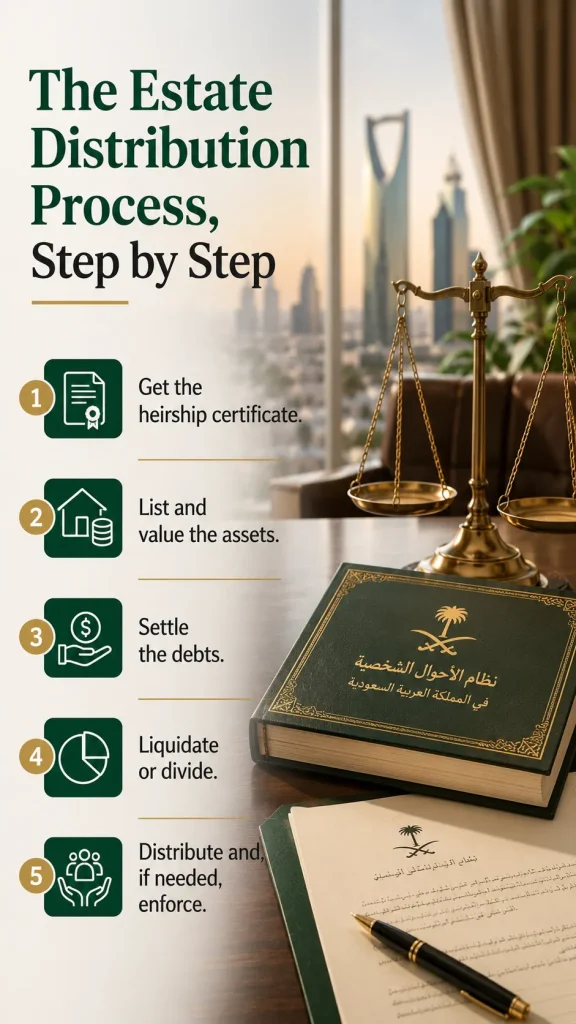
Now let us walk through the Saudi Arabia estate distribution process steps so you know what to expect. This is the practical heart of the Saudi Arabia estate liquidation process.
Step 1 Get the heirship certificate. The first official document is the inheritance deed, or Sakk Hasr al-Warathah. People often search heirship certificate Saudi Arabia how to get, and the process is this: the heirs apply to the competent court (often through the Ministry of Justice channels), provide the death certificate, identity papers, and witnesses, and the court issues a deed naming every lawful heir and their share. Nothing major can be transferred without it.
Step 2 List and value the assets. Record every asset and liability bank accounts, property, vehicles, shares, and end-of-service pay.
Step 3 Settle the debts. Valid debts are paid before any heir receives a share. Where money is owed to the estate, our collection services can help recover it.
Step 4 Liquidate or divide. Some assets are split directly; others, such as a single property, may be sold so the value can be shared. We handle this stage through our asset management and estate liquidation services.
Step 5 Distribute and, if needed, enforce. Each heir receives their share per the deed. If one party refuses to cooperate, ourlitigation services and enforcement services make sure the court’s ruling is carried out.
Is There Any Tax?
Here is a piece of relief. On the question of Saudi Arabia inheritance no tax, the Kingdom does not charge an inheritance tax or an estate tax. Heirs do not pay tax simply for receiving their share. There may still be other costs for example fees linked to transferring property but the inheritance itself is not taxed. This is one of the friendliest features of the system.
How We Help Families and Expats
Estate matters are emotional, and the legal terms can feel heavy. Our role is to make the path simple: drafting a valid will within the one-third rule, securing the heirship certificate, valuing and liquidating assets, settling debts, and distributing shares correctly. As trusted legal advisors in Saudi Arabia, we guide both Saudi families and foreign residents from the first step to the last. You can learn more about our firm and then contact us for a private consultation.
Planning today is the kindest thing you can do for the people you love. Let us help you put it in order.

Frequently Asked Questions
1. Can A Will Override Sharia Inheritance In Saudi Arabia?
No, not fully. A will (wasiyya) works inside the system, not against it. You can direct up to one-third of your estate through a will, but the remaining two-thirds must pass to the fixed heirs by their legal shares. A bequest to someone who is already an heir usually needs the written agreement of all other heirs.
2. How Much Of My Estate Can I Leave In A Will In Saudi Arabia?
Up to one-third of your estate. This is the well-known one-third rule. The one-third is most useful for leaving assets to people or causes outside the normal heir list, such as a charity or a friend. The other two-thirds is distributed by the fixed Sharia shares.
3. Does Saudi Arabia Have Inheritance Tax?
No. Saudi Arabia does not impose an inheritance tax or estate tax, so heirs do not pay tax just for receiving their share. Be aware that other charges, such as property transfer fees, may still apply depending on the assets involved.
4. What Is An Heirship Certificate In Saudi Arabia?
It is the official inheritance deed (Sakk Hasr al-Warathah) issued by the competent court. It names every lawful heir and their share. It is the key document that allows banks, the property registry, and other bodies to release and transfer the deceased’s assets. Almost nothing can be settled without it.
5. Can A Non-Muslim Expat Write A Will In Saudi Arabia?
Yes. A non-Muslim expat can and should record a clear, notarised will. While Saudi courts generally apply Islamic principles to assets inside the Kingdom, a registered will stating your wishes including a request to apply home-country law gives the court something clear to consider and reduces disputes. Local legal advice is essential, because recognition is not automatic.
6. What Happens To A Bank Account When Someone Dies In Saudi Arabia?
The account is usually frozen once the bank learns of the death. The funds become part of the estate and cannot be released until the heirs are confirmed by the heirship certificate, debts are settled, and the court-recognised shares are calculated.
7. How Long Does Estate Settlement Take In Saudi Arabia?
It depends on the estate. A simple case with clear documents and cooperating heirs can be settled in a few months. Cases with property, business shares, cross-border assets, or disputes among heirs take longer. Good preparation a valid will and organised records is the fastest way to shorten the process.saudi-labor-law-compliance-consultation.webp